The Wilhelm Gustloff
The Man & The Ship
1936 - 1937
The Man & The Ship
1936 - 1937






The 1937 Wilhelm Gustloff Launch Film:
"Mein Schiff"
"Mein Schiff"
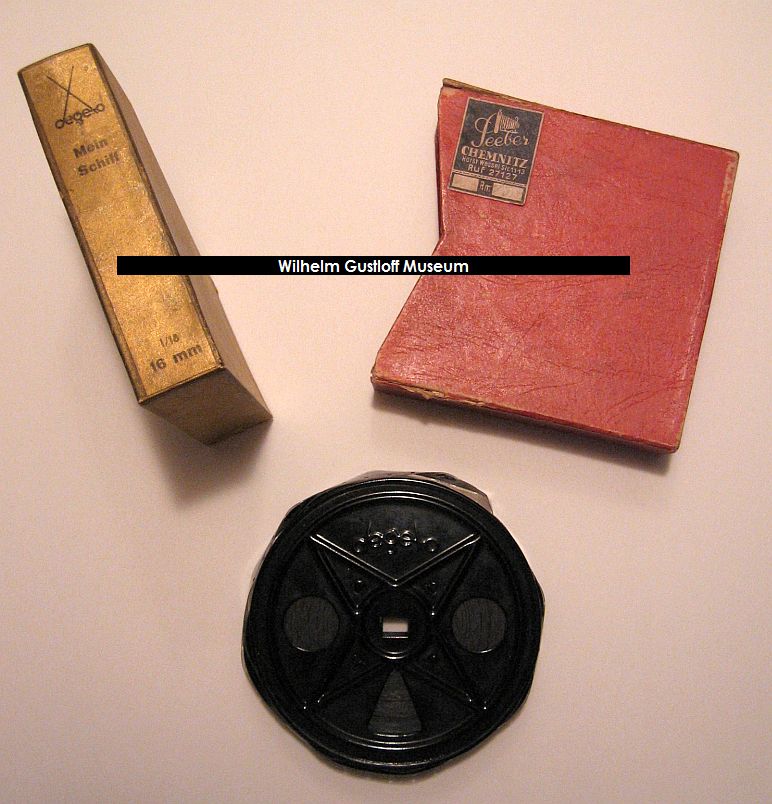
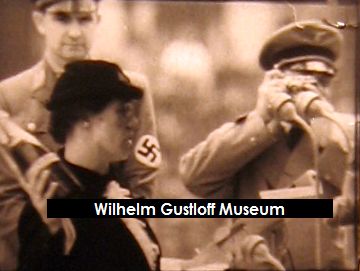
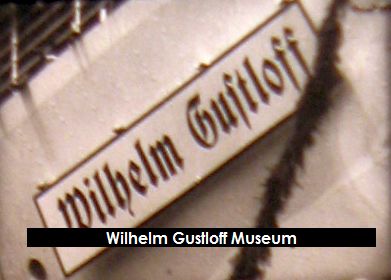
The two most notable Wilhelm Gustloff films are her maiden voyage film: Schiff ohne Klassen (Ship Without Classes) and her construction & launch film Schiff 754 (Ship 754). This next film is a third one on the Gustloff not heard of until a copy surfaced. Mein Schiff, or My Ship, is a 4 to 5 minute film on the Wilhelm Gustloff's construction and launch without sound. I have never seen Schiff 754 in its entirety, but several images from this film are the same. It may be the same release under a different name, or a different film with many of the same shots of the liner. On 16mm film for home viewing, below are several images from the film. It was converted to DVD and contains no sound.
Time to explore the M.S. Wilhelm Gustloff deck by deck!
By Dave Krawczyk: It is January 31st, 1936 - nine years less a day before three torpedoes strike the Wilhelm Gustloff, sending it to the bottom of the Baltic Sea. David Frankfurter, a struggling 25 year old Jewish medical student studying in Switzerland, is leaving Bern by train carrying only a briefcase.
His destination is Davos - a 170 mile train ride via Zurich. The purpose of his journey has nothing to do with his studies. His mission is to assassinate Wilhelm Gustloff, leader (or Landesgruppenleiter) of the NSDAP (Nazi party) in Switzerland.
Frankfurter checks himself into the Hotel Metropol-Löwen in Davos and will wait until the 4th of February to attempt his daunting task. Why he chooses this date is open to debate. Some claim it is sheer procrastination or tortured self-doubt. Others claim he had been closely tracking his target - reading newspapers and Party material that document dates of public appearances - aware that Gustloff would be returning to Davos on the 3rd. Either way, the 4th falls on a Tuesday, considered a Jewish day of good luck (Ki Tov). Clearly this idea pleases the would-be assassin. In the meantime, he anonymously explores the picturesque winter-resort town, known for its towering peaks and clean, dry air. In his room, the revolver he purchased for only 10 francs in Bern remains discreetly tucked away in his briefcase.
Historical hindsight being as it is, it is easy to understand why Frankfurter viewed the Nazis as a threat. His own direct personal experiences with growing anti-Semitism in Germany had influenced his retreat into "neutral" Switzerland - ultimately providing a safer haven for his decision to take action against the Nazi menace. Steadily, his studies become compromised by overwhelming fixation with the anti-Semitic charged political environment. Periodicals such as Der Stürmer and the
His destination is Davos - a 170 mile train ride via Zurich. The purpose of his journey has nothing to do with his studies. His mission is to assassinate Wilhelm Gustloff, leader (or Landesgruppenleiter) of the NSDAP (Nazi party) in Switzerland.
Frankfurter checks himself into the Hotel Metropol-Löwen in Davos and will wait until the 4th of February to attempt his daunting task. Why he chooses this date is open to debate. Some claim it is sheer procrastination or tortured self-doubt. Others claim he had been closely tracking his target - reading newspapers and Party material that document dates of public appearances - aware that Gustloff would be returning to Davos on the 3rd. Either way, the 4th falls on a Tuesday, considered a Jewish day of good luck (Ki Tov). Clearly this idea pleases the would-be assassin. In the meantime, he anonymously explores the picturesque winter-resort town, known for its towering peaks and clean, dry air. In his room, the revolver he purchased for only 10 francs in Bern remains discreetly tucked away in his briefcase.
Historical hindsight being as it is, it is easy to understand why Frankfurter viewed the Nazis as a threat. His own direct personal experiences with growing anti-Semitism in Germany had influenced his retreat into "neutral" Switzerland - ultimately providing a safer haven for his decision to take action against the Nazi menace. Steadily, his studies become compromised by overwhelming fixation with the anti-Semitic charged political environment. Periodicals such as Der Stürmer and the
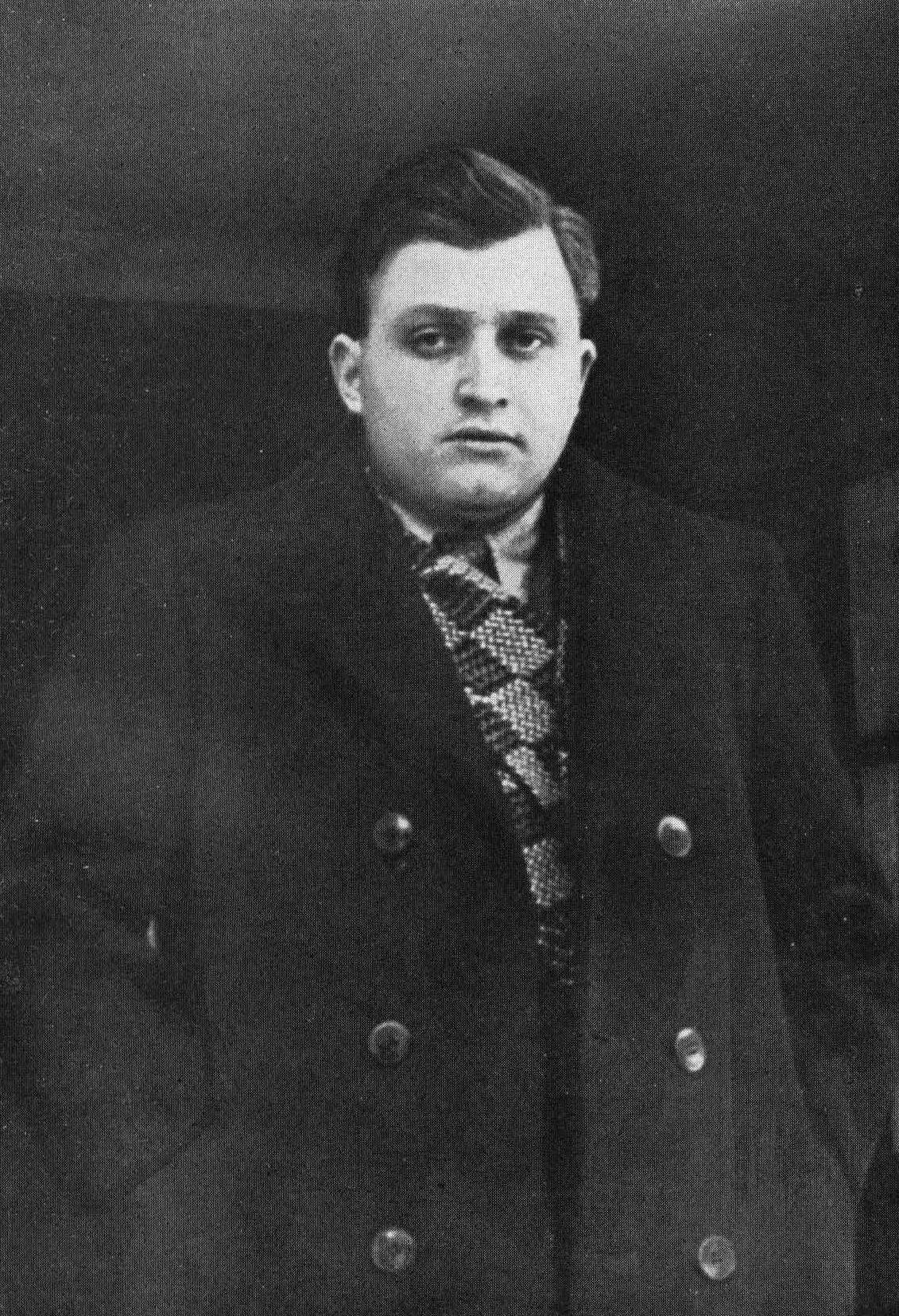
Portrait photo of Wilhelm Gustloff in 1936.
Launch of the new Kraft Durch Freude Flagship
M.S. Wilhelm Gustloff: May 5th, 1937
Weight:
25,484 GRT (Gross Registered Tons)
Length:
208.5 metres (684 feet)
Width:
23.5 metres (77 feet)
Height:
56 metres (184 feet) keel to masthead
Engines:
Four 8-cylinder MAN diesel engines
Shafts/Props:
2 (“twin-screw”). 4 blades per prop
Horsepower:
9,500 hp
Anchors:
3 (1 port, 2 starboard)
25,484 GRT (Gross Registered Tons)
Length:
208.5 metres (684 feet)
Width:
23.5 metres (77 feet)
Height:
56 metres (184 feet) keel to masthead
Engines:
Four 8-cylinder MAN diesel engines
Shafts/Props:
2 (“twin-screw”). 4 blades per prop
Horsepower:
9,500 hp
Anchors:
3 (1 port, 2 starboard)
Speed:
15.5 knots (approx. 29 km/h or 18 mph)
Range:
12,000 nautical miles @ 15 knots
Passengers:
1,463
Crew:
417
Passenger Cabins:
489 (248 two-bed and 241 four-bed)
Classes:
Only 1
Number of Decks:
8
Deck Space:
5,000 square metres
15.5 knots (approx. 29 km/h or 18 mph)
Range:
12,000 nautical miles @ 15 knots
Passengers:
1,463
Crew:
417
Passenger Cabins:
489 (248 two-bed and 241 four-bed)
Classes:
Only 1
Number of Decks:
8
Deck Space:
5,000 square metres
Watertight Bulkheads:
12
Plumbing:
50 bathrooms, 100 showers, 145 toilets
Lifeboats:
22 - Standard boats capacity of 95 people.
Builder:
Blohm & Voss, Hamburg
Yard #:
511
Owner:
Deutsche Arbeitsfront (DAF) - KdF
Interior Design:
Professor Woldemar Brinkmann, Munich
Cost:
25 Million Reichmarks
12
Plumbing:
50 bathrooms, 100 showers, 145 toilets
Lifeboats:
22 - Standard boats capacity of 95 people.
Builder:
Blohm & Voss, Hamburg
Yard #:
511
Owner:
Deutsche Arbeitsfront (DAF) - KdF
Interior Design:
Professor Woldemar Brinkmann, Munich
Cost:
25 Million Reichmarks
Managed By:
Hamburg-South America Line
Radio ID:
DJVZ
Keel Laid:
August 4, 1936
Launch:
May 5, 1937
Delivery:
March 15, 1938
Cost of Linens to furnish the ship:
1/2 Million Reichsmarks
Candlepower:
8,000 @ 40 Watt.
*Additional statistics are available in my book: The M.S. Wilhelm Gustloff - Construction to Maiden Voyage.
Hamburg-South America Line
Radio ID:
DJVZ
Keel Laid:
August 4, 1936
Launch:
May 5, 1937
Delivery:
March 15, 1938
Cost of Linens to furnish the ship:
1/2 Million Reichsmarks
Candlepower:
8,000 @ 40 Watt.
*Additional statistics are available in my book: The M.S. Wilhelm Gustloff - Construction to Maiden Voyage.
25,000 tons of a KdF ship one can enjoy from the decks! - The festive launch of the holiday ship "Wilhelm Gustloff" - a ship built by workers for workers! - A symbol of German socialism - Thousands came to the ceremony.
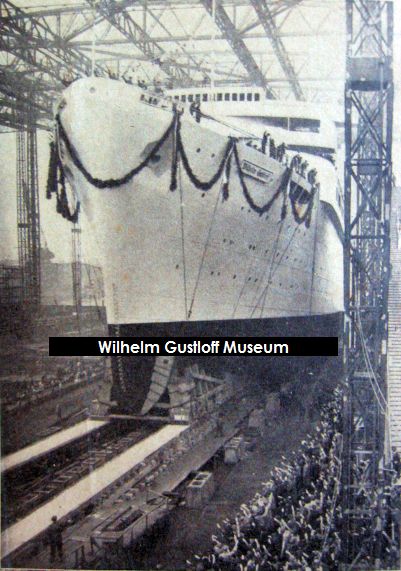
An endless chain of people passed through the wide open gates of the shipyard Blohm + Voss in Hamburg. One is immediately faced with the overwhelming image of the giant ship body, the scaffolding and the rest of the steel slipway. Certainly, those in attendance made all kinds of fuss, so powerful and so elegant at the same time, we were happy to see the first type of this ship in the world though! So that was it, built by workers, financed by workers, created for workers! Could this sleek bow, this magnificent structure not compare to any luxury yacht with the same bow and with every modern luxury? No, really everything was different about this ship, the multitude of portholes in the hull - (Every vacationer can now stay in a cabin with direct light!) - The big, wide windows of the hall-like Promenade Deck, the swinging gates of the command bridge and the command post. Tiny, like Lilliputians, are the few people who are high on the spacious grandstands that extended along the port side. At the shipyard, workers rested for a few short hours during the morning's ceremony. The shipyard was busy with other workers on the bow of the ship. They stood in groups in their working clothes, with sooty faces and hands. With their hammers and files they were waiting to witness the great moment of consecration, which was the work of their hands. They knew the great ship as it should run, now solemnly waiting before the world's eyes on the ramp. In and out, they knew about each nail for each rivet to the toil and labor in day and night hours, in which each of them accomplished great things. Their ship was still, they almost did not want to give it away! Then in the hours of celebration they felt joy and happiness with the launch held before them. "Would you also belong to those who would sail with this ship?", from which her operator, Blohm State Council, said in his address there. "A monument and a landmark for the will of the Führer!" There was already the additional desire to travel and it would be great in the foreign countries. On their faces was already the joy of expectation. And with the tension and the very intimate feelings they had, they pursued the course of the ceremony. They jubilantly greeted the Führer, as he walked through a forest of banners on the rostrum, accompanied with cheering of their approval to the words of Dr. Ley, as he explained them, that would have to comply with this ship on a mission. They undertook a march to the sounds of the factory after the Frau Gustloff christened the ship.
"Wilhelm Gustloff" slowly and majestically glided on the water as their enthusiasm knew no bounds! All too soon it was all over. All too soon, even the beautiful, proud ship had slipped from our sight. So we hired a ride in the late afternoon when the tourists' seven ships, accompanied by the Führer's Aviso Grille, already downriver of the lake left. We left the Wilhelm Gustloff, now laying in the water. We floated by the snow-white mountain looking up at that which loomed before us, because our impression was actually even lower than before. Still, it loomed up far above the keel line from the water by its size nor increasing. The engineer accompanied us gave us a few figures. He said its a 37m height of the ship from keel to funnel edge. The smoke stack itself encloses an interior space of 5 to 11 meters, it would comfortably fit two very large rooms in its interior, which would be 13 meters high! The size of the ship length is 208m, the maximum breadth of 24 meters. 1,460 people can fit onboard, where 248 two-bed and 241 four bed cabins are fitted. Between the guest cabins and those of the 400 man crew there is no difference. All German landscapes have helped to build the ship. Even here it was again the distressed areas, which were concerned with jobs, so is the steel from the Ruhr and Saar, anchors and chains from the Ruhr area and Magdeburg, boats of the Lower Weser, engines from Cologne, windows from Hamburg, glass from central Germany, insulating from the Lüneburg heath, Stosse of some things, and Silesia. Once the establishment of the ship is done, stories can be told of workmates who had the good fortune to join a holiday cruise on the "Wilhelm Gustloff!". B.R.
An endless chain of people passed through the wide open gates of the shipyard Blohm + Voss in Hamburg. One is immediately faced with the overwhelming image of the giant ship body, the scaffolding and the rest of the steel slipway. Certainly, those in attendance made all kinds of fuss, so powerful and so elegant at the same time, we were happy to see the first type of this ship in the world though! So that was it, built by workers, financed by workers, created for workers! Could this sleek bow, this magnificent structure not compare to any luxury yacht with the same bow and with every modern luxury? No, really everything was different about this ship, the multitude of portholes in the hull - (Every vacationer can now stay in a cabin with direct light!) - The big, wide windows of the hall-like Promenade Deck, the swinging gates of the command bridge and the command post. Tiny, like Lilliputians, are the few people who are high on the spacious grandstands that extended along the port side. At the shipyard, workers rested for a few short hours during the morning's ceremony. The shipyard was busy with other workers on the bow of the ship. They stood in groups in their working clothes, with sooty faces and hands. With their hammers and files they were waiting to witness the great moment of consecration, which was the work of their hands. They knew the great ship as it should run, now solemnly waiting before the world's eyes on the ramp. In and out, they knew about each nail for each rivet to the toil and labor in day and night hours, in which each of them accomplished great things. Their ship was still, they almost did not want to give it away! Then in the hours of celebration they felt joy and happiness with the launch held before them. "Would you also belong to those who would sail with this ship?", from which her operator, Blohm State Council, said in his address there. "A monument and a landmark for the will of the Führer!" There was already the additional desire to travel and it would be great in the foreign countries. On their faces was already the joy of expectation. And with the tension and the very intimate feelings they had, they pursued the course of the ceremony. They jubilantly greeted the Führer, as he walked through a forest of banners on the rostrum, accompanied with cheering of their approval to the words of Dr. Ley, as he explained them, that would have to comply with this ship on a mission. They undertook a march to the sounds of the factory after the Frau Gustloff christened the ship.
"Wilhelm Gustloff" slowly and majestically glided on the water as their enthusiasm knew no bounds! All too soon it was all over. All too soon, even the beautiful, proud ship had slipped from our sight. So we hired a ride in the late afternoon when the tourists' seven ships, accompanied by the Führer's Aviso Grille, already downriver of the lake left. We left the Wilhelm Gustloff, now laying in the water. We floated by the snow-white mountain looking up at that which loomed before us, because our impression was actually even lower than before. Still, it loomed up far above the keel line from the water by its size nor increasing. The engineer accompanied us gave us a few figures. He said its a 37m height of the ship from keel to funnel edge. The smoke stack itself encloses an interior space of 5 to 11 meters, it would comfortably fit two very large rooms in its interior, which would be 13 meters high! The size of the ship length is 208m, the maximum breadth of 24 meters. 1,460 people can fit onboard, where 248 two-bed and 241 four bed cabins are fitted. Between the guest cabins and those of the 400 man crew there is no difference. All German landscapes have helped to build the ship. Even here it was again the distressed areas, which were concerned with jobs, so is the steel from the Ruhr and Saar, anchors and chains from the Ruhr area and Magdeburg, boats of the Lower Weser, engines from Cologne, windows from Hamburg, glass from central Germany, insulating from the Lüneburg heath, Stosse of some things, and Silesia. Once the establishment of the ship is done, stories can be told of workmates who had the good fortune to join a holiday cruise on the "Wilhelm Gustloff!". B.R.
Die Frau am Werk - June 1937
Article on the launch of the Wilhelm Gustloff
Article on the launch of the Wilhelm Gustloff
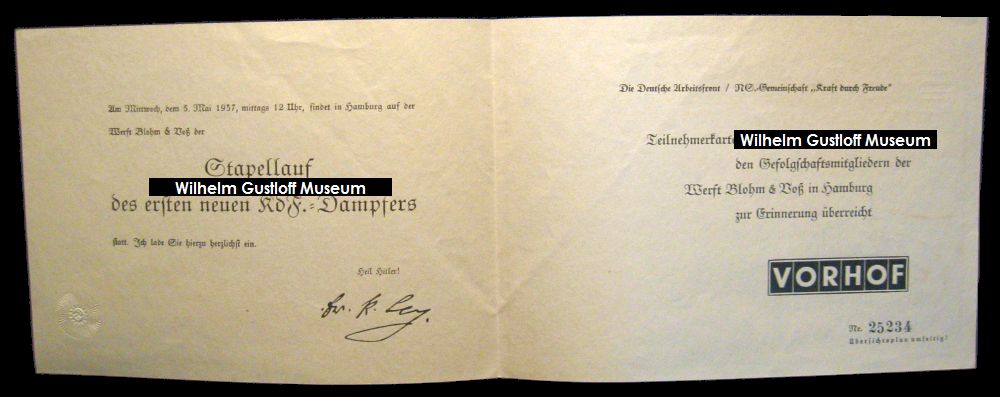
Inside Left:
On Wednesday, the 5th May 1937, at 12:00 in the afternoon, held in Hamburg at the Blohm & Voss of the launch of the first new KdF steamship. I cordially invite you to this one.
Heil Hitler!
Dr. R. Ley
On Wednesday, the 5th May 1937, at 12:00 in the afternoon, held in Hamburg at the Blohm & Voss of the launch of the first new KdF steamship. I cordially invite you to this one.
Heil Hitler!
Dr. R. Ley
Inside Right:
The German Workers Front / N.S. community "Strength Through Joy"
Participants Map
The following members of the Blohm & Voss in Hamburg presented in memory
VORHOF
No. 25234
General plan overleaf!
The German Workers Front / N.S. community "Strength Through Joy"
Participants Map
The following members of the Blohm & Voss in Hamburg presented in memory
VORHOF
No. 25234
General plan overleaf!
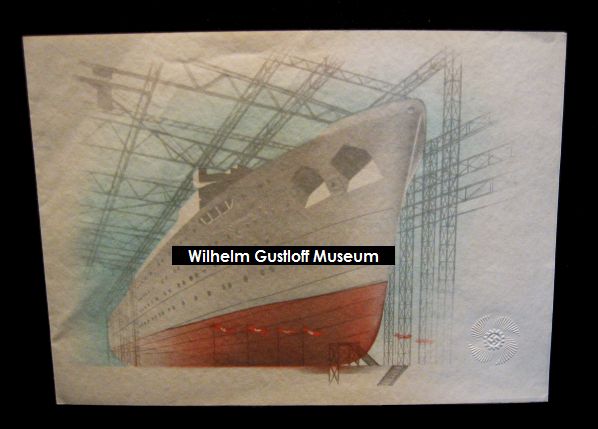
Beautiful launch invitation for the 'unnamed' KdF ship Wilhelm Gustloff at Blohm & Voss. This is a general invitation card, opposed to one for specialized seating in the grandstands. Only a few hundred were grandstand seats, while over 25,000 were admitted for the general seating / standing areas at the shipyard. Measures 8x6 inches when folded shut & embossed with the KdF symbol on the cover.
Wehrarbeit - Berlin, June 1937. 2. Jahrgang.
Launching of the Wilhelm Gustloff.
Probably one of the best articles on the launch of the ship due to the detailed account of the activity at Blohm & Voss that day. Features several snippets of the speeches given on the day of her launch.
Launching of the Wilhelm Gustloff.
Probably one of the best articles on the launch of the ship due to the detailed account of the activity at Blohm & Voss that day. Features several snippets of the speeches given on the day of her launch.
Right: Second Wilhelm Gustloff launch invitation.
Different information on the opposite interior page.
Different information on the opposite interior page.
Kampf der Gefahr
Num. 2
4th year, June 1937
Launch of the First KdF ship
Where does that still exist in the world? A steamer is launched in Hamburg, its sole task is to take German working people to countries that they had only known from hearsay. A socialist deed in every aspect, which cannot be diminished by even the most negative professional moaners and grousers. We say: A socialist deed in every aspect. A state or an organization that had intended to give the workers a pittance, would have taken an old crate freshly painted and the case would have been closed. To the national socialist state for the workers the best is only barely good enough. The KdF vacation ship “Wilhelm Gustloff “that was launched on May 5, is the best proof for this assertion. “Wilhelm Gustloff “ accommodates 1,460 vacationers, all occupying two or four bed cabins. All cabins go to the outside, a solution not even found on all passenger ships. The roughly 400 men crew is housed in exactly the same cabins. Where else do you find this in the world, passengers and crew staying in the same type of cabin?
Num. 2
4th year, June 1937
Launch of the First KdF ship
Where does that still exist in the world? A steamer is launched in Hamburg, its sole task is to take German working people to countries that they had only known from hearsay. A socialist deed in every aspect, which cannot be diminished by even the most negative professional moaners and grousers. We say: A socialist deed in every aspect. A state or an organization that had intended to give the workers a pittance, would have taken an old crate freshly painted and the case would have been closed. To the national socialist state for the workers the best is only barely good enough. The KdF vacation ship “Wilhelm Gustloff “that was launched on May 5, is the best proof for this assertion. “Wilhelm Gustloff “ accommodates 1,460 vacationers, all occupying two or four bed cabins. All cabins go to the outside, a solution not even found on all passenger ships. The roughly 400 men crew is housed in exactly the same cabins. Where else do you find this in the world, passengers and crew staying in the same type of cabin?
Kampf der Gefahr: Nr. 2 / 4. Jahrgang - June 1937
Launch of the First KdF Steamship
Launch of the First KdF Steamship
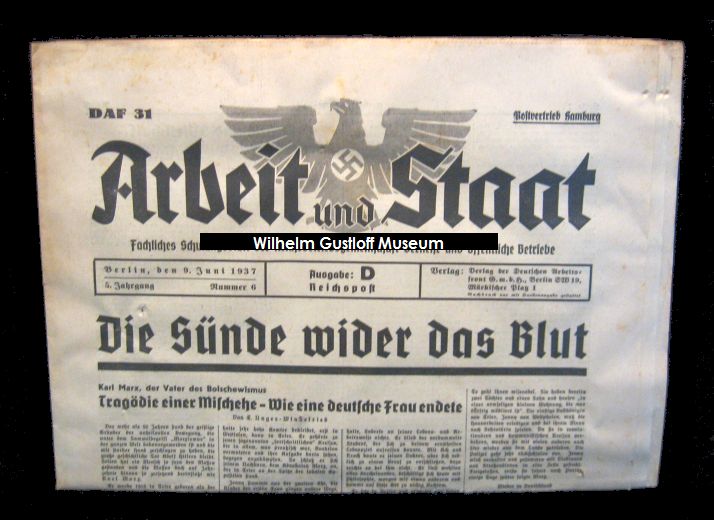
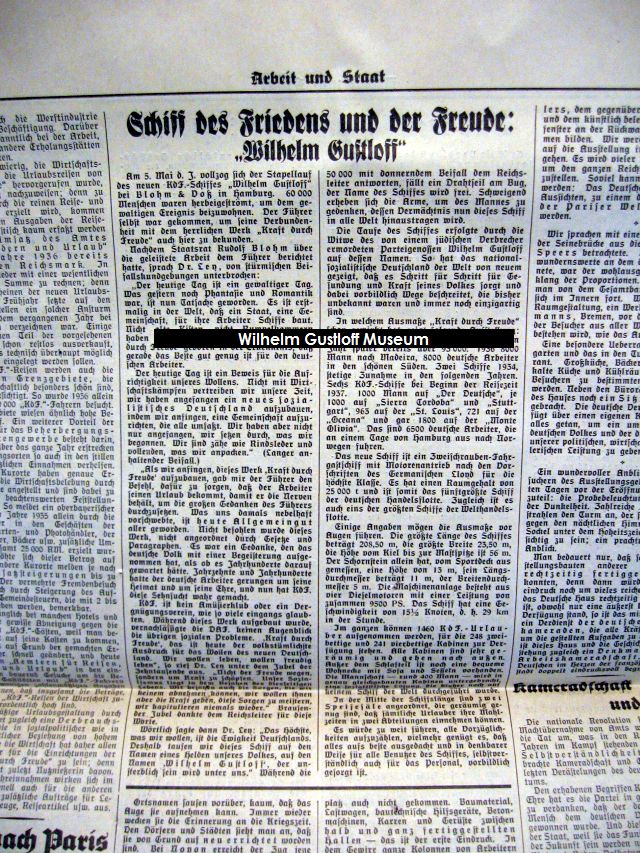
Arbeit und Staat - Berlin, 9. Juni 1937
Article: Schiff des Friedens und der Freude "Wilhelm Gustloff"
Features the speech given at the launch of the Wilhelm Gustloff, along with information about the new KdF ship.
Shown below are the articles translated into English. Many thanks to Werner Hinke for translating these next three articles for me.
Article: Schiff des Friedens und der Freude "Wilhelm Gustloff"
Features the speech given at the launch of the Wilhelm Gustloff, along with information about the new KdF ship.
Shown below are the articles translated into English. Many thanks to Werner Hinke for translating these next three articles for me.
Arbeit und Staat
Berlin June 9, 1937
Article: Ship of Peace and Joy “Wilhelm Gustloff”
Features the speech given at the launch of the Wilhelm Gustloff, along with information about the new KdF ship.
Ship of Peace and Joy: Wilhelm Gustloff
On May 5 of this year the launch of the new KdF ship “Wilhelm Gustloff “took place in Hamburg at the Blohm + Voss shipyard. 60,000 gathered to witness the massive event. The Führer himself had come to demonstrate his adhesion to the magnificent work “Kraft durch Freude" here also. After the state counselor Rudolf Blohm had reported to the Führer about the work completed, Dr. Ley spoke interrupted by roaring manifestations of applause. “Today is a momentous day. What appeared yesterday to be fantasy and romanticism has now become reality. It is unique in the world that a state, a community builds ships for its workers. We did not take old relics or junkyards. We created “Kraft durch Freude “knowing that only the best is good enough for the German worker.
This day today is proof of the sincerity of our will. We do not waste our time with economic struggles; we have begun to build a new socialist Germany, by beginning to build a community that embraces everyone. But not only did we begin, we finish what we begin. We are tough as leather and we complete what we put our hands to.” (Long sustained applause). “When we began to construct this work Kraft durch Freude, the Führer instructed me to ensure that the worker enjoys his vacations in order to maintain the nerves to be able to give substance to the great ideas of the Führer. What appeared to be shrouded in fog is today present in everyone's mind. This work was not commanded, not directed by law and paragraphs. It was an idea that was adopted by the people with excitement, as if it had waited for it for centuries. During decades and centuries has the German worker fought for his homeland and his honor, and now the KdF has made his desire come true.
KdF is not an amusement club nor a have-fun-group, as many believed initially. While this work was in its first stage, the DAF did not for moment neglect the other social problems. 'Kraft durch Freude' that is today's popular expression for the will of the new Germany. We want to live, want to live joyously.” Thus shouted Dr. Ley to the acclaim of the tens of thousands. “Not because of the joy, but for the strength for creation. Our socialism stresses the positive emphasis of this life on earth. We also affirm the sorrows that we cannot remove from anybody, we want to give you the strength to, master these sorrows, and we will not capitulate ever again.” A roaring applause thanked the Reichsleiter for these remarks.
And we quote Dr. Ley´s next words: “The highest value that we want to achieve for Germany is eternity. Therefore we christen the ship with the name of a hero of this people, with the name of Wilhelm Gustloff who is immortal to us.” While the 50,000 answer the Reichsleiter with a thunderous applause, a steel cable drops at the bow releasing the name of the ship. In silence the arms are raised in memory of the man whose legacy will now be carried by this ship into the whole world.
The christening of the ship with the name of Wilhelm Gustloff was performed by the widow of the party member Wilhelm Gustloff murdered by a Jewish criminal. The national socialist Germany has once again shown the world that it concerns itself step by step with the healing and strength of its people and walks along exemplary paths that were once unknown and are still unique. The following list shows how much “Kraft durch Freude" has impacted: 1934 leaving from Hamburg 62,800 voyagers, one year later already more than 93,000. 1936 8,000 to Madeira, 8,000 German workers to the beautiful South. 2 ships in 1934, continuous increase in the following years. Six ships “KdF” beginning the 1937 season. 1,000 people on the Der Deutsche, 1,000 each of the Sierra Cordoba and Stuttgart, 963 on the St. Louis, and 721 on the Oceana and even 1,800 on the Monte Olivia. That adds up to 6,500 German workers, leaving on a single day from Hamburg with destination Norway. The new ship is a twin –screw passenger ship with engine propulsion according to the regulations of the German Lloyd registry for the highest class. It holds a volume of 25,000t and is therefore the fifth largest ship of the German merchant fleet. At the same time it is also one the largest ships in the world's merchant fleet. Some data may make the dimensions visible. The overall length is 208.50 mts; the largest width is 23.50 mts, overall height from keel to top of mast 56 mts. The chimney, measured from the Sports Deck has a height of 13 mts, its longest diameter 11 mts; the widest diameter is 5 mts. The propulsion consists of 4 diesel engines with a combined output of 9500 HP. The speed is 15.5 knots, i.e. 29 kmh. In total the ship can carry 1,460 vacationers, accommodated in 248 2-bed cabins and 241 four-bed cabins. All cabins are very spacious and are on the outside. Apart from the sleeping area the cabin contains a sitting corner with couch and lounge chairs. The crew – about 400 persons – sleep in cabins equipped in exactly the same manner, a socialist solution that had not been realized onboard any ship in the world. In the middle of the ship two dining halls are placed that are ample enough to accommodate all vacationers for meals in two settings. It would become too extensive to describe all the advantages, let it suffice to say that everything is well thought out and it serves all users of the ships, the crew included of course, in an exemplary fashion.
Berlin June 9, 1937
Article: Ship of Peace and Joy “Wilhelm Gustloff”
Features the speech given at the launch of the Wilhelm Gustloff, along with information about the new KdF ship.
Ship of Peace and Joy: Wilhelm Gustloff
On May 5 of this year the launch of the new KdF ship “Wilhelm Gustloff “took place in Hamburg at the Blohm + Voss shipyard. 60,000 gathered to witness the massive event. The Führer himself had come to demonstrate his adhesion to the magnificent work “Kraft durch Freude" here also. After the state counselor Rudolf Blohm had reported to the Führer about the work completed, Dr. Ley spoke interrupted by roaring manifestations of applause. “Today is a momentous day. What appeared yesterday to be fantasy and romanticism has now become reality. It is unique in the world that a state, a community builds ships for its workers. We did not take old relics or junkyards. We created “Kraft durch Freude “knowing that only the best is good enough for the German worker.
This day today is proof of the sincerity of our will. We do not waste our time with economic struggles; we have begun to build a new socialist Germany, by beginning to build a community that embraces everyone. But not only did we begin, we finish what we begin. We are tough as leather and we complete what we put our hands to.” (Long sustained applause). “When we began to construct this work Kraft durch Freude, the Führer instructed me to ensure that the worker enjoys his vacations in order to maintain the nerves to be able to give substance to the great ideas of the Führer. What appeared to be shrouded in fog is today present in everyone's mind. This work was not commanded, not directed by law and paragraphs. It was an idea that was adopted by the people with excitement, as if it had waited for it for centuries. During decades and centuries has the German worker fought for his homeland and his honor, and now the KdF has made his desire come true.
KdF is not an amusement club nor a have-fun-group, as many believed initially. While this work was in its first stage, the DAF did not for moment neglect the other social problems. 'Kraft durch Freude' that is today's popular expression for the will of the new Germany. We want to live, want to live joyously.” Thus shouted Dr. Ley to the acclaim of the tens of thousands. “Not because of the joy, but for the strength for creation. Our socialism stresses the positive emphasis of this life on earth. We also affirm the sorrows that we cannot remove from anybody, we want to give you the strength to, master these sorrows, and we will not capitulate ever again.” A roaring applause thanked the Reichsleiter for these remarks.
And we quote Dr. Ley´s next words: “The highest value that we want to achieve for Germany is eternity. Therefore we christen the ship with the name of a hero of this people, with the name of Wilhelm Gustloff who is immortal to us.” While the 50,000 answer the Reichsleiter with a thunderous applause, a steel cable drops at the bow releasing the name of the ship. In silence the arms are raised in memory of the man whose legacy will now be carried by this ship into the whole world.
The christening of the ship with the name of Wilhelm Gustloff was performed by the widow of the party member Wilhelm Gustloff murdered by a Jewish criminal. The national socialist Germany has once again shown the world that it concerns itself step by step with the healing and strength of its people and walks along exemplary paths that were once unknown and are still unique. The following list shows how much “Kraft durch Freude" has impacted: 1934 leaving from Hamburg 62,800 voyagers, one year later already more than 93,000. 1936 8,000 to Madeira, 8,000 German workers to the beautiful South. 2 ships in 1934, continuous increase in the following years. Six ships “KdF” beginning the 1937 season. 1,000 people on the Der Deutsche, 1,000 each of the Sierra Cordoba and Stuttgart, 963 on the St. Louis, and 721 on the Oceana and even 1,800 on the Monte Olivia. That adds up to 6,500 German workers, leaving on a single day from Hamburg with destination Norway. The new ship is a twin –screw passenger ship with engine propulsion according to the regulations of the German Lloyd registry for the highest class. It holds a volume of 25,000t and is therefore the fifth largest ship of the German merchant fleet. At the same time it is also one the largest ships in the world's merchant fleet. Some data may make the dimensions visible. The overall length is 208.50 mts; the largest width is 23.50 mts, overall height from keel to top of mast 56 mts. The chimney, measured from the Sports Deck has a height of 13 mts, its longest diameter 11 mts; the widest diameter is 5 mts. The propulsion consists of 4 diesel engines with a combined output of 9500 HP. The speed is 15.5 knots, i.e. 29 kmh. In total the ship can carry 1,460 vacationers, accommodated in 248 2-bed cabins and 241 four-bed cabins. All cabins are very spacious and are on the outside. Apart from the sleeping area the cabin contains a sitting corner with couch and lounge chairs. The crew – about 400 persons – sleep in cabins equipped in exactly the same manner, a socialist solution that had not been realized onboard any ship in the world. In the middle of the ship two dining halls are placed that are ample enough to accommodate all vacationers for meals in two settings. It would become too extensive to describe all the advantages, let it suffice to say that everything is well thought out and it serves all users of the ships, the crew included of course, in an exemplary fashion.
N.S. Funk: Folge 19, 9. Mai 1937
Building the Wilhelm Gustloff.
Building the Wilhelm Gustloff.
NS Funk , Folge 19, 19.Mai 1937
Building the Wilhelm Gustloff : Giants of the Oceans: Built for German workers
Radio reports from the launch of the first KDF community ship that took place on May 5.
4th Recordings Press Office DAF (of which Wiesebach 2, Wolf 1)
A herald of German socialism - The first giant KdF ocean liner, launched on May 5, under construction.
All over the world there are hundreds of thousands of shipyard workers. They build ship after ship, and every time a ship is completed, their work goes out to sea. But they stay behind with their great longing to be travelling. For the first time in the history of mankind ships are being built in Hamburg which have a different future. These are the new ships of the German Labor Front (DAF). They are being built on behalf of “Kraft durch Freude” and everyone who is working on them knows that they themselves will be on board one of these days, that they themselves will enjoy their labor. The first of these new giants of the ocean of about 25,000 tons was launched on May 5, the second one follows in a few months, and more shall be built, a whole fleet for socialism and peace, for the sole purpose that German workers, who would otherwise not be able to afford it can take their vacations making beautiful trips on the high seas. Every purpose finds its shape. The ships that until now and for some time to come travelled for “Kraft durch Freude" originated in previous days and were built according to capitalist principles which means that the same will be used in the intensive way- it has to produce money. Cargo space and machinery are built in; cabins are for different classes etc. While travelling on these ships has meant a great mind shaking experience- everyone who has participated knows it, these do not present the complete solution for the purpose of the N.S. community of “Kraft durch Freude“.
That shall be achieved with these new ships. Trips with KdF are community trips, nobody will receive preferential treatment, nobody pays higher prices than the next one; whether he is a factory worker or an employee makes not the least difference; they are all people on vacations, comrades and nothing else. This mutual equality has determined the shape of the new ships, and it was even possible to make improvements to an extent not possible to find on any other ship in the world. There are only cabins with four and two beds, all cabins are to the outside and include apart from the sleeping area which contains running cold and warm water, a sitting area with sofa, table and lounge chairs. In addition a real socialist consequence: the members of the crew have the same cabins, built with the same quality and furnishings as those for the passengers, an achievement which is also unique in the world.
The ship that will be launched on May 5 will be the fifth largest of the German merchant fleet. It has a deck area of 5,000 sq.mts for a capacity of 1,460 vacationers. Smoking lounges, dance halls etc. are large enough to hold all the passengers in bad weather, without having to make use of the dining halls. It will be a beautiful ship, a comfortable ship, in accordance with the slogan. For the worker the best is just good enough. A gym will be provided and also an elevator to connect the seven decks with each other.
The German people are looking with pride as this new fashioned work grows. When these new “KdF” ships cruise over the oceans and will travel in 1940 as is planned with thousands of German workers to the Olympics in Japan, the Marxist countries need to show whether they have anything even remotely similar to that of the supposedly antiworker Germany. E. Moes
Building the Wilhelm Gustloff : Giants of the Oceans: Built for German workers
Radio reports from the launch of the first KDF community ship that took place on May 5.
4th Recordings Press Office DAF (of which Wiesebach 2, Wolf 1)
A herald of German socialism - The first giant KdF ocean liner, launched on May 5, under construction.
All over the world there are hundreds of thousands of shipyard workers. They build ship after ship, and every time a ship is completed, their work goes out to sea. But they stay behind with their great longing to be travelling. For the first time in the history of mankind ships are being built in Hamburg which have a different future. These are the new ships of the German Labor Front (DAF). They are being built on behalf of “Kraft durch Freude” and everyone who is working on them knows that they themselves will be on board one of these days, that they themselves will enjoy their labor. The first of these new giants of the ocean of about 25,000 tons was launched on May 5, the second one follows in a few months, and more shall be built, a whole fleet for socialism and peace, for the sole purpose that German workers, who would otherwise not be able to afford it can take their vacations making beautiful trips on the high seas. Every purpose finds its shape. The ships that until now and for some time to come travelled for “Kraft durch Freude" originated in previous days and were built according to capitalist principles which means that the same will be used in the intensive way- it has to produce money. Cargo space and machinery are built in; cabins are for different classes etc. While travelling on these ships has meant a great mind shaking experience- everyone who has participated knows it, these do not present the complete solution for the purpose of the N.S. community of “Kraft durch Freude“.
That shall be achieved with these new ships. Trips with KdF are community trips, nobody will receive preferential treatment, nobody pays higher prices than the next one; whether he is a factory worker or an employee makes not the least difference; they are all people on vacations, comrades and nothing else. This mutual equality has determined the shape of the new ships, and it was even possible to make improvements to an extent not possible to find on any other ship in the world. There are only cabins with four and two beds, all cabins are to the outside and include apart from the sleeping area which contains running cold and warm water, a sitting area with sofa, table and lounge chairs. In addition a real socialist consequence: the members of the crew have the same cabins, built with the same quality and furnishings as those for the passengers, an achievement which is also unique in the world.
The ship that will be launched on May 5 will be the fifth largest of the German merchant fleet. It has a deck area of 5,000 sq.mts for a capacity of 1,460 vacationers. Smoking lounges, dance halls etc. are large enough to hold all the passengers in bad weather, without having to make use of the dining halls. It will be a beautiful ship, a comfortable ship, in accordance with the slogan. For the worker the best is just good enough. A gym will be provided and also an elevator to connect the seven decks with each other.
The German people are looking with pride as this new fashioned work grows. When these new “KdF” ships cruise over the oceans and will travel in 1940 as is planned with thousands of German workers to the Olympics in Japan, the Marxist countries need to show whether they have anything even remotely similar to that of the supposedly antiworker Germany. E. Moes
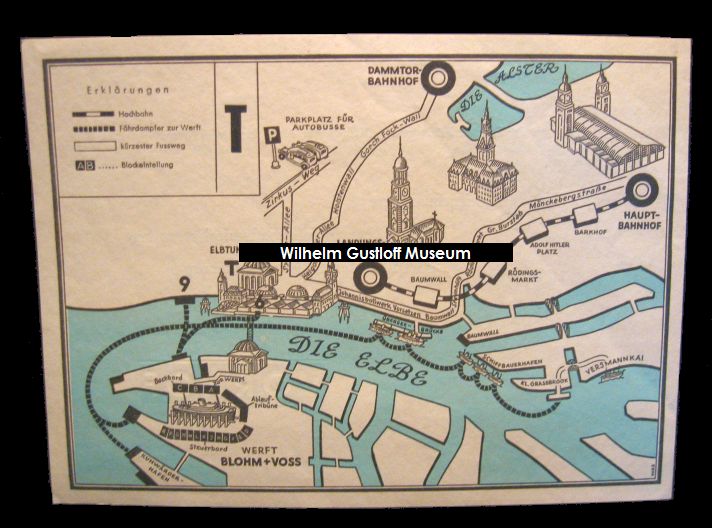
Inside Right: Variation 2:
The German Labor Front / NS Community "Strength through Joy." For your attention!
Because the ceremony starts sharp at 11am, the participants are kindly asked to take their seats at the yard by 10am at the latest. For the journey from D. Der Deutsche to the shipyard and back, special green steamers of the Harbor steamship A.G. will be provided by the Hamburg KdF service. Time specification on board by the KdF tour guide. It is impossible to visit the shipyard.
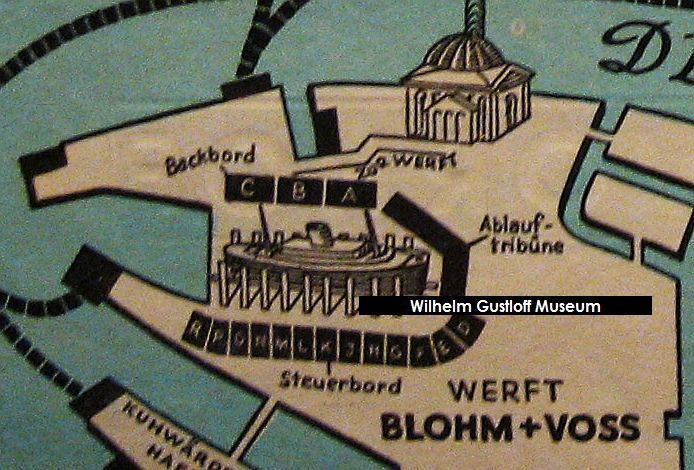
This place allocation - Starboard side / Block M. Must be kept strictly: No. 15019. Overview plan overleaf.
The German Labor Front / NS Community "Strength through Joy." For your attention!
Because the ceremony starts sharp at 11am, the participants are kindly asked to take their seats at the yard by 10am at the latest. For the journey from D. Der Deutsche to the shipyard and back, special green steamers of the Harbor steamship A.G. will be provided by the Hamburg KdF service. Time specification on board by the KdF tour guide. It is impossible to visit the shipyard.
This place allocation - Starboard side / Block M. Must be kept strictly: No. 15019. Overview plan overleaf.
Original launch footage of the
Wilhelm Gustloff - May 5th, 1937
"Ich taufe dich auf den Namen, Wilhelm Gustloff."
("I baptize you in the name, Wilhelm Gustloff.")
Frau Hedwig Gustloff
At the launching of the Wilhelm Gustloff.
Wilhelm Gustloff - May 5th, 1937
"Ich taufe dich auf den Namen, Wilhelm Gustloff."
("I baptize you in the name, Wilhelm Gustloff.")
Frau Hedwig Gustloff
At the launching of the Wilhelm Gustloff.
The launch of the KdF ship "Wilhelm Gustloff"
Photos and article inside the cover.
Hamburg's first birthday. The ship of the KdF tourists is launched in the presence of the Creator of Great Hamburg on May 5th, 1937. Endless cheers accompanied the leaders from their train station to the jetties, where he is greeted by a true celebration concert of sirens. In a barge, Adolf Hitler moves through the harbor, where many have flagged vessels of various ports coming to Blohm & Voss. Again and again the welcoming cries of those in Hamburg can be heard as he enters the festively decorated shipyard. Before the start of the celebrations, the director of the shipyard gives an illuminating lecture on the art of a ship build. He takes something like this: The manufacture of the vessel to the finished bodyshell work requires a lot of work. Which first requires a keel plate that was laid on August 4th, 1936. In nine months of work are concatenated disk to disk and are welded and riveted until today these made the massive hull. The length of the structure is more than 200 meters, the width is more than 23 meters and the height is 17 meters up to the Promenade Deck. It can approximately hold 1,500 passengers and 400 crew members are housed, all equally for men only in cabins two or four.
9,000 tons of steel and other materials are processed to date in this huge mass now placed into motion. The shipbuilders use a slippery slope. Even the yard where the ship is built, receives a certain slope to later facilitate the construction of the slipway. The ship is always placed so that the bow stands high in the country as the first tail section lies on the water. The running track consists of two adjacent carriages, of which the lower part, the solid impact bed stands on the ground, while the upper part, the running board is connected to the hull. The track itself is composed of two layers of talc and soap is used in a specific weight ratio, so that the upper layer is able to slide on the bottom. In this building about 3,500 kilograms of talc and 1,300 kilograms tallow soap have been consumed.
The hull is not built from the beginning on these cars, it will be built on special stacking wood. About 3 months before the launch begins with the production of the running track. It is performed by accurately calculated data, it is also clear here, what intimate connection between the work of the hand and the head in the whole technology prevails. What the engineer devises must work to bring man into shape. First, the fixed part of the flow path is established to this, the lower down gangways, then lubricated first with tallow, then soap. After also the upper raceway is smeared with tallow, it is placed on the bottom web. Now begins the construction of the upper part of the carriage, in which the hull is at rest. The wood must be lined to the form of the ship and exactly match. Especially the front end which is carefully calculated, shored and executed because this component on the subsequent flotation must absorb a large part of the forces. The weight of the hull, the first still rests on the stack timber, the top web is wedged hard against the hull. Only then is the timber stack are chipped away so that the entire weight rests on the carriage, and thus now the slipway.
Thus now the set stopper at the very moment begins to hold and the vessel is not about to slide down by itself, are provided between the upper and lower stoppers arranged web, which are released at the appropriate time by means of hydraulic pressure. Moreover, even special supporting timbers are provided as a stopper. Although usually the ships glide down automatically on the crooked path, it is still at the front end set up powerful presses that provide the impetus, and help overcome the friction. After the kick the ship glides inexorably down, first slowly, then faster and faster until it after about a minute, leaving the fixed web.
On leaving the ship, it sometimes makes a little bow, and then floats freely in the water. Now engage the chains that hang on the side. The anchored one end of the ketteist attached to the ship, the other is below the ship. In a short time to bring the ship to a halt. With tugs it is brought to the quay in order completed.
Party Member Dr. Lafferenz, Reichsamt director of the Office "traveling, hiking and vacation" in the NSG. Has "Strength through Joy" reported to the Fuhrer that the launching of the first own KdF ship some 50,000 German men and women are gathered, heads of Gauleiter and Reich Governor Kaufmann at the ceremony of launching followed by words of welcome to the leader.
Subsequently State Rudolph Blohm known some technical data about the ship and tells the driver:
"You, my guide, I'll report on behalf of the shipyard, the cruising boat, hull number 511, ready to launch!"
Then comes Reich Organization Leader of the NSDAP., Dr. Ley, the mic and talks about the size of this company of the Third Reich. Place in economic struggles and bargaining to waste our time, we are building a new social Germany. It is the will of the leader, the German workers to provide only the best. Therefore received Pg Dr. Ley then leader of the command: "Make sure that the German worker gets his vacation, so he keeps his nerve, because I could do or not do what I wanted, it would be pointless if the German people's nerves would not okay. It is important that the German national, the German masses, the German workers are strong enough to understand my thoughts." Dr. Ley thanked all the men who helped directly or indirectly, to create such a work. The idea of "strength through joy" has become the common property of the German people. It is not imposed from above, but the people received him as if it had been waiting for centuries thereafter. The worker has previously wrestled in vain to his homeland in order. Recognition of his honor. The leader has had this longing to be truth. "Strength through joy", which is now the most popular of expression of the will of the new Germany. "We want to live like, happy life," exclaims Dr. Ley from the cheers of tens of thousands of "Not just of joy but because of our ability to draw from strength. Our socialism lies in the affirmation of this life. We also affirm the concerns we can not lose, but we want him (Hitler) to give strength to overcome these concerns, we never surrender again! The highest of what we want, which is Germany's eternity!" At the end of his speech, Dr. Ley announced the name of the person on the ship to be baptized: "Wilhelm Gustloff".
While the crowd with thunderous applause the Reich Organization Leader replied that the name of the ship is free. Dr. Ley thanks again to the workers of the yard and brings the thanks of all. To the leader with a threefold Sieg Heil on Adolf Hitler expressed that absorb the masses excited. The widow of the murdered Landesgruppen leader christens the beautiful ship with the words:
"I baptize you in the name, Wilhelm Gustloff."
Wedges are sold off, hydraulic brakes come into operation, and slowly the ship moves. The speaker gives the first greeting: "Holidaymakers ship 'Wilhelm Gustloff' Prosperous Voyage," and the ship glides to its element. The leader repeatedly thanked the enthusiastic cheers of the population and leaves the shipyard to the start of the six KdF ships that will soon extend to Norway. "Wilhelm Gustloff"
The new ship, with a capacity of 25,000 tons is one of the largest ships of the world fleet and the fifth largest ship of the German merchant fleet to the ships "Europa", "Bremen", "Columbus", and "Cap Arcona." For the leisure traveler can check into 248 and 241 double-bedded cabins with room for two or four. All cabins are spacious and look outward. The cabins contain except the sleeping part a comfortable living area with a sofa and armchairs. The crew will be located in exactly the same built cabins, a socialist solution, which one finds yet on any ship in the world.
In the middle of the ship's length two dining rooms are built, spacious enough for all the tourists can enjoy their meals in two departments. The common areas for tourists are so great that all the same convenient place to find without the dining rooms need to be outside of meals had for that purpose. On the main Promenade Deck is a smoke stack 40 meters long and 15 meters wide. Next there are 4 smaller rooms of 25 meters long and 15 meters wide. All rooms are equipped with a public address system for announcements and music transmission on board as well as for radio remote reception, a facility for sound film screening is also available. The large Sun Deck and two promenade decks are available for exercise. The lower main Promenade Deck is protected through sliding glass against wind and rain. The Upper Promenade Deck variables, just as the Sun Deck, which is totally free of any structures or equipment. The total area of the deck is about 5,000 square meters, an area as big on ships of this size not yet known. The areas are large enough that all the tourists it also can find a deck chair and is also plenty of room for board games, etc. yet. The length of a path three times on the Lower Promenade Deck is about 1 kilometer. Nowhere is the view is obstructed by lifeboats or other objects. On the Sun Deck, a spacious gymnasium is equipped with numerous devices installed. Here we find more than an imaginary porch. A swimming pool with a pool size of 10 m long and 5 m wide is located in E Deck.
The tourists have over 40 bathrooms and 100 shower departments. A large elevator connects people to each other through the different decks. Even retail stores for consumer items, photo products, tobacco products, biscuits, etc, also hair salons and various offices are not missing. For safeguards 22 rescue boats are available, 20 of which are equipped with a diesel engine drive, two of the boats are also equipped with full radio equipment and lighting assembly. The hull is protected by a double floor damage when touching ground and divided by steel cross walls into 13 watertight compartments. The upper vessel is fire retardant by transverse and longitudinal walls largely to protect against spread of fire, etc. All the other walls are covered by non-burning paint.
Through the construction of this gigantic tourist ship, it has been possible to assign a number of jobs to the areas. If the new KdF ship starts its first journey, one can say with truth that it is the most modern and the only one to purely socialist perspective built ship in the world, not exaggerated, predicting that in the commissioning of the new KdF ship in the entire shipbuilding industry, a new era begins. We Germans can be proud of the way in so many areas we are groundbreaking and move forward and the rest of the world to give an example of what can be done when you do with socialism seriously! Meilick
Photos and article inside the cover.
Hamburg's first birthday. The ship of the KdF tourists is launched in the presence of the Creator of Great Hamburg on May 5th, 1937. Endless cheers accompanied the leaders from their train station to the jetties, where he is greeted by a true celebration concert of sirens. In a barge, Adolf Hitler moves through the harbor, where many have flagged vessels of various ports coming to Blohm & Voss. Again and again the welcoming cries of those in Hamburg can be heard as he enters the festively decorated shipyard. Before the start of the celebrations, the director of the shipyard gives an illuminating lecture on the art of a ship build. He takes something like this: The manufacture of the vessel to the finished bodyshell work requires a lot of work. Which first requires a keel plate that was laid on August 4th, 1936. In nine months of work are concatenated disk to disk and are welded and riveted until today these made the massive hull. The length of the structure is more than 200 meters, the width is more than 23 meters and the height is 17 meters up to the Promenade Deck. It can approximately hold 1,500 passengers and 400 crew members are housed, all equally for men only in cabins two or four.
9,000 tons of steel and other materials are processed to date in this huge mass now placed into motion. The shipbuilders use a slippery slope. Even the yard where the ship is built, receives a certain slope to later facilitate the construction of the slipway. The ship is always placed so that the bow stands high in the country as the first tail section lies on the water. The running track consists of two adjacent carriages, of which the lower part, the solid impact bed stands on the ground, while the upper part, the running board is connected to the hull. The track itself is composed of two layers of talc and soap is used in a specific weight ratio, so that the upper layer is able to slide on the bottom. In this building about 3,500 kilograms of talc and 1,300 kilograms tallow soap have been consumed.
The hull is not built from the beginning on these cars, it will be built on special stacking wood. About 3 months before the launch begins with the production of the running track. It is performed by accurately calculated data, it is also clear here, what intimate connection between the work of the hand and the head in the whole technology prevails. What the engineer devises must work to bring man into shape. First, the fixed part of the flow path is established to this, the lower down gangways, then lubricated first with tallow, then soap. After also the upper raceway is smeared with tallow, it is placed on the bottom web. Now begins the construction of the upper part of the carriage, in which the hull is at rest. The wood must be lined to the form of the ship and exactly match. Especially the front end which is carefully calculated, shored and executed because this component on the subsequent flotation must absorb a large part of the forces. The weight of the hull, the first still rests on the stack timber, the top web is wedged hard against the hull. Only then is the timber stack are chipped away so that the entire weight rests on the carriage, and thus now the slipway.
Thus now the set stopper at the very moment begins to hold and the vessel is not about to slide down by itself, are provided between the upper and lower stoppers arranged web, which are released at the appropriate time by means of hydraulic pressure. Moreover, even special supporting timbers are provided as a stopper. Although usually the ships glide down automatically on the crooked path, it is still at the front end set up powerful presses that provide the impetus, and help overcome the friction. After the kick the ship glides inexorably down, first slowly, then faster and faster until it after about a minute, leaving the fixed web.
On leaving the ship, it sometimes makes a little bow, and then floats freely in the water. Now engage the chains that hang on the side. The anchored one end of the ketteist attached to the ship, the other is below the ship. In a short time to bring the ship to a halt. With tugs it is brought to the quay in order completed.
Party Member Dr. Lafferenz, Reichsamt director of the Office "traveling, hiking and vacation" in the NSG. Has "Strength through Joy" reported to the Fuhrer that the launching of the first own KdF ship some 50,000 German men and women are gathered, heads of Gauleiter and Reich Governor Kaufmann at the ceremony of launching followed by words of welcome to the leader.
Subsequently State Rudolph Blohm known some technical data about the ship and tells the driver:
"You, my guide, I'll report on behalf of the shipyard, the cruising boat, hull number 511, ready to launch!"
Then comes Reich Organization Leader of the NSDAP., Dr. Ley, the mic and talks about the size of this company of the Third Reich. Place in economic struggles and bargaining to waste our time, we are building a new social Germany. It is the will of the leader, the German workers to provide only the best. Therefore received Pg Dr. Ley then leader of the command: "Make sure that the German worker gets his vacation, so he keeps his nerve, because I could do or not do what I wanted, it would be pointless if the German people's nerves would not okay. It is important that the German national, the German masses, the German workers are strong enough to understand my thoughts." Dr. Ley thanked all the men who helped directly or indirectly, to create such a work. The idea of "strength through joy" has become the common property of the German people. It is not imposed from above, but the people received him as if it had been waiting for centuries thereafter. The worker has previously wrestled in vain to his homeland in order. Recognition of his honor. The leader has had this longing to be truth. "Strength through joy", which is now the most popular of expression of the will of the new Germany. "We want to live like, happy life," exclaims Dr. Ley from the cheers of tens of thousands of "Not just of joy but because of our ability to draw from strength. Our socialism lies in the affirmation of this life. We also affirm the concerns we can not lose, but we want him (Hitler) to give strength to overcome these concerns, we never surrender again! The highest of what we want, which is Germany's eternity!" At the end of his speech, Dr. Ley announced the name of the person on the ship to be baptized: "Wilhelm Gustloff".
While the crowd with thunderous applause the Reich Organization Leader replied that the name of the ship is free. Dr. Ley thanks again to the workers of the yard and brings the thanks of all. To the leader with a threefold Sieg Heil on Adolf Hitler expressed that absorb the masses excited. The widow of the murdered Landesgruppen leader christens the beautiful ship with the words:
"I baptize you in the name, Wilhelm Gustloff."
Wedges are sold off, hydraulic brakes come into operation, and slowly the ship moves. The speaker gives the first greeting: "Holidaymakers ship 'Wilhelm Gustloff' Prosperous Voyage," and the ship glides to its element. The leader repeatedly thanked the enthusiastic cheers of the population and leaves the shipyard to the start of the six KdF ships that will soon extend to Norway. "Wilhelm Gustloff"
The new ship, with a capacity of 25,000 tons is one of the largest ships of the world fleet and the fifth largest ship of the German merchant fleet to the ships "Europa", "Bremen", "Columbus", and "Cap Arcona." For the leisure traveler can check into 248 and 241 double-bedded cabins with room for two or four. All cabins are spacious and look outward. The cabins contain except the sleeping part a comfortable living area with a sofa and armchairs. The crew will be located in exactly the same built cabins, a socialist solution, which one finds yet on any ship in the world.
In the middle of the ship's length two dining rooms are built, spacious enough for all the tourists can enjoy their meals in two departments. The common areas for tourists are so great that all the same convenient place to find without the dining rooms need to be outside of meals had for that purpose. On the main Promenade Deck is a smoke stack 40 meters long and 15 meters wide. Next there are 4 smaller rooms of 25 meters long and 15 meters wide. All rooms are equipped with a public address system for announcements and music transmission on board as well as for radio remote reception, a facility for sound film screening is also available. The large Sun Deck and two promenade decks are available for exercise. The lower main Promenade Deck is protected through sliding glass against wind and rain. The Upper Promenade Deck variables, just as the Sun Deck, which is totally free of any structures or equipment. The total area of the deck is about 5,000 square meters, an area as big on ships of this size not yet known. The areas are large enough that all the tourists it also can find a deck chair and is also plenty of room for board games, etc. yet. The length of a path three times on the Lower Promenade Deck is about 1 kilometer. Nowhere is the view is obstructed by lifeboats or other objects. On the Sun Deck, a spacious gymnasium is equipped with numerous devices installed. Here we find more than an imaginary porch. A swimming pool with a pool size of 10 m long and 5 m wide is located in E Deck.
The tourists have over 40 bathrooms and 100 shower departments. A large elevator connects people to each other through the different decks. Even retail stores for consumer items, photo products, tobacco products, biscuits, etc, also hair salons and various offices are not missing. For safeguards 22 rescue boats are available, 20 of which are equipped with a diesel engine drive, two of the boats are also equipped with full radio equipment and lighting assembly. The hull is protected by a double floor damage when touching ground and divided by steel cross walls into 13 watertight compartments. The upper vessel is fire retardant by transverse and longitudinal walls largely to protect against spread of fire, etc. All the other walls are covered by non-burning paint.
Through the construction of this gigantic tourist ship, it has been possible to assign a number of jobs to the areas. If the new KdF ship starts its first journey, one can say with truth that it is the most modern and the only one to purely socialist perspective built ship in the world, not exaggerated, predicting that in the commissioning of the new KdF ship in the entire shipbuilding industry, a new era begins. We Germans can be proud of the way in so many areas we are groundbreaking and move forward and the rest of the world to give an example of what can be done when you do with socialism seriously! Meilick
Did you know?
- It took 3500 kilograms of tallow and 1300 kilograms of soap to launch the Wilhelm Gustloff into the Elbe!
- It took 3500 kilograms of tallow and 1300 kilograms of soap to launch the Wilhelm Gustloff into the Elbe!

Portrait photo of David Frankfurter.
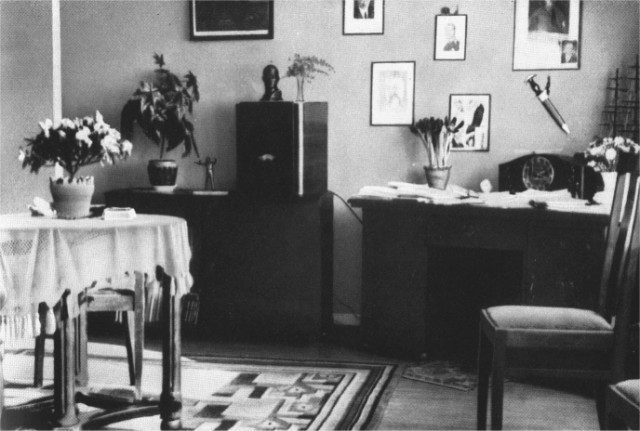
Nuremburg Laws passed in Germany during 1935 only fuel his resolve and conviction. By the time Frankfurter purchases his short-barrel Browning revolver, he claims to feel like "an insignificant weapon in the hand of God". Tuesday the 4th arrives. Snow crunching under his feet, Frankfurter walks up to the front door of the Gustloff residence. After ringing the doorbell, Gustloff's wife, Hedwig, calls down from upstairs. "Is Herr Gustloff at home and can I speak with him?" he calls back. She is used to her husband having many visitors, so without a second thought she leads Frankfurter through the house to Gustloff's study. He promptly takes a seat. For five minutes his eyes peruse Nazi regalia including a picture of Hitler signed for Gustloff. Thoughts roll around his head like a storm. He clutches the revolver hidden in his coat pocket and at the ready. Gustloff strides in the room and greets his guest with "Here I am!" Without any response, David Frankfurter fires his revolver. Four shots hit their mark in Gustloff's head and upper body. Frau Hedwig enters the room just after the final shot and sees her husband lying crumpled, bleeding and dying on the floor of the study. In haste, Frankfurter passes her without saying a word and leaves through the front door as the sounds of her cries ring in his ears. Frankfurter has no intention of running from his premeditated deed, but he leaves the scene dazed, unstable, and contemplating suicide. He remains of the conviction that his act is not a crime - it is a strike at the Nazi menace and revenge for the "spilled blood of Israel". He even returns to the scene of the crime to telephone the police from elderly neighbors. Regardless, he eventually walks to the nearest police station and turns himself in.
After some initial disbelief on the part of an officer on duty, Frankfurter does not leave any doubt as to his culpability. He makes a confession to the officer - explaining that he fired the shots not for personal reasons, but because he is a Jew. He further explains that he if fully aware of his actions and is without regret. Later, he will repeat similar statements in a Swiss court - robbing the trial of any suspense. The Nazis are anxious to use this opportunity to exploit the assassination of Gustloff to further the causes of an anti-Semitic agenda. Only the Olympic games and the Führer's deliberate patience for retaliation subdue an outright attack on the Jewish community. It is unlikely that many in the world (including perhaps many in Germany itself) had heard of Gustloff. However, being the first Nazi leader to be assassinated by a Jew, the Nazis are determined to make him a martyr. A garish state funeral on February 12th ensues in his birthplace of Schwerin, only after his casket takes a long journey of "martyrdom" from Davos through many towns on the way to his final resting place.
It is during this memorial service for the Swiss Nazi leader that the superstitious Führer exploits an opportunity to rename a groundbreaking ship originally destined to bear his name - a project just recently commissioned to be built for the KdF by Blohm + Voss shipyard. When the ship is launched next spring, it will be renamed the Wilhelm Gustloff.
After some initial disbelief on the part of an officer on duty, Frankfurter does not leave any doubt as to his culpability. He makes a confession to the officer - explaining that he fired the shots not for personal reasons, but because he is a Jew. He further explains that he if fully aware of his actions and is without regret. Later, he will repeat similar statements in a Swiss court - robbing the trial of any suspense. The Nazis are anxious to use this opportunity to exploit the assassination of Gustloff to further the causes of an anti-Semitic agenda. Only the Olympic games and the Führer's deliberate patience for retaliation subdue an outright attack on the Jewish community. It is unlikely that many in the world (including perhaps many in Germany itself) had heard of Gustloff. However, being the first Nazi leader to be assassinated by a Jew, the Nazis are determined to make him a martyr. A garish state funeral on February 12th ensues in his birthplace of Schwerin, only after his casket takes a long journey of "martyrdom" from Davos through many towns on the way to his final resting place.
It is during this memorial service for the Swiss Nazi leader that the superstitious Führer exploits an opportunity to rename a groundbreaking ship originally destined to bear his name - a project just recently commissioned to be built for the KdF by Blohm + Voss shipyard. When the ship is launched next spring, it will be renamed the Wilhelm Gustloff.
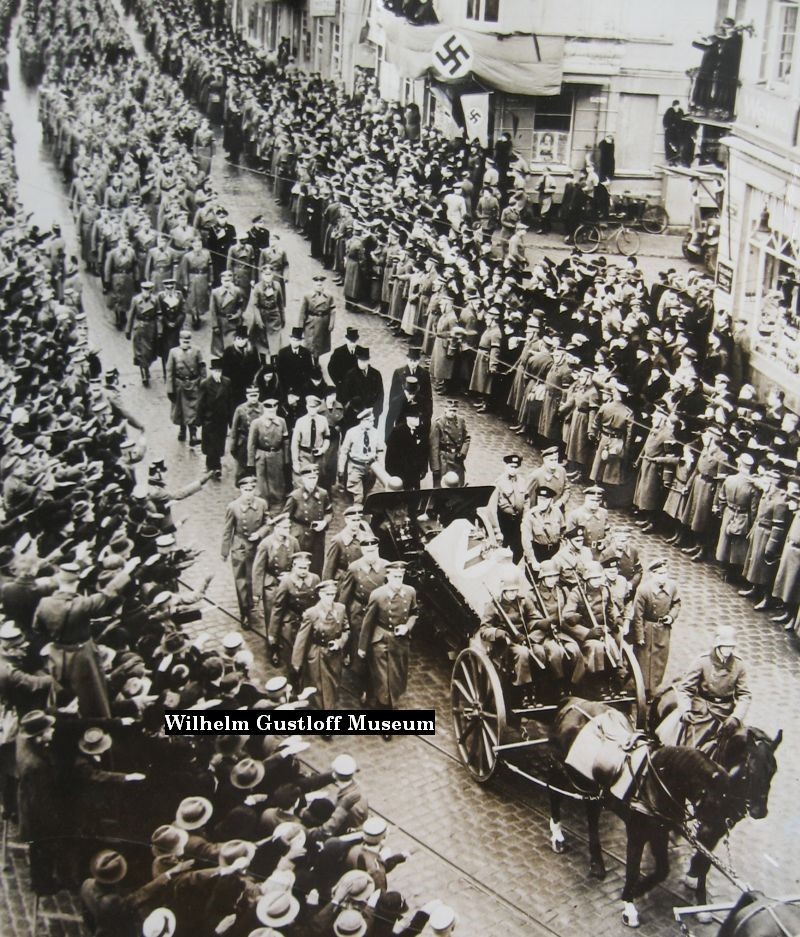
Right: Nazis Honored Leader Slain in Switzerland: Followed by the high Nazi command and state officials with a military escort, the swastika-draped casket containing the body of Wilhelm Gustloff, Nazi leader who was slain in Davos, Switzerland by David Frankfurter, is shown passing through the streets of Schwerin, Germany. During the elaborate funeral, Chancellor Hitler delivered the speech hinting that Frankfurter's act would have consequences on Jews in Germany. Dated February 21st, 1936 though his funeral was held on February 12th, 1936.
Below: Berliner Illustrirte Zeitung, February 20th, 1936. News article and photographs from Wilhelm Gustloff's funeral and Hitler's speech.
Below: Berliner Illustrirte Zeitung, February 20th, 1936. News article and photographs from Wilhelm Gustloff's funeral and Hitler's speech.
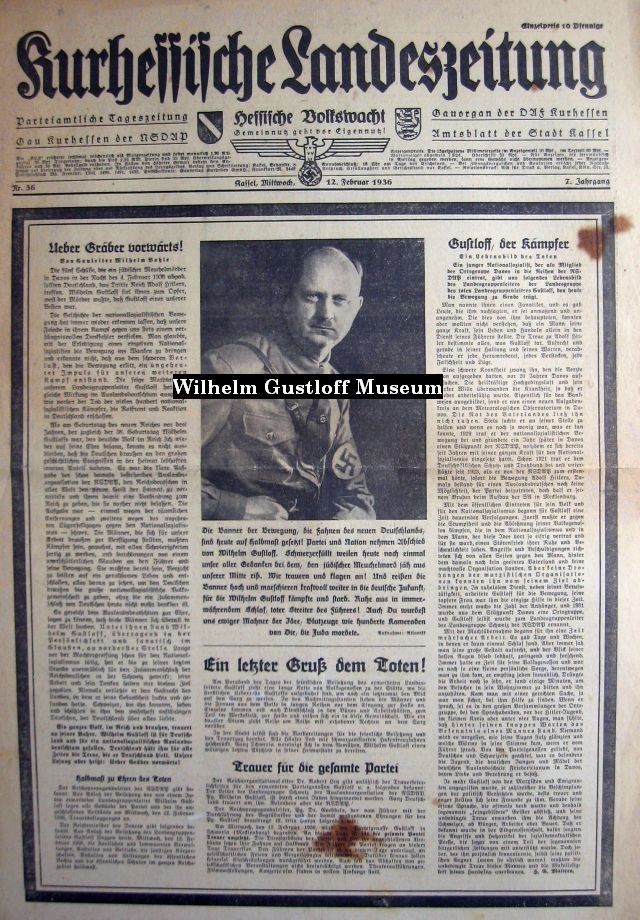
Gustloff, the Fighter - Tragedy for the Party!
February 12th, 1936: Hessian State Newspaper
Mourning for the Entire Party
"The movement of the banners and flags of the new Germany, are now set to half-mast! A party and nation bid farewell to Wilhelm Gustloff. The pain we bore is felt once again today, our thoughts are with the man who the Jewish assassin tore abruptly from our midst. We mourn and wail! And take the banner high and march powerfully to continue for the German future, fought and died for by Wilhelm Gustloff. Tranquility in everlasting sleep, dead soldier and our leader! Also you were eternal to us, admonished the martyr idea like hundreds of comrades of you who murdered Judah."
They were called fanatics, and there were people who told him that he was a matter of conscience and unpleasant. Those who claimed this could not or would not understand that a man put his whole strength, his life, and acted alone in the service of his leader. The loyalty to Adolf Hitler determined everything Gustloff did. Upright and straight forward in his attitude and his words, he pushed away every revolt, every concealment, every falsehood.
At a young age, a severe illness had forced him close to death, the physicians had already given up twenty years ago, but told him to seek out Davos. The healing mountain air and his strong will overcame the disease made him so that he became able to work again.
Actually trained for banking, he now found a new task at the Meterological Observatory in Davos. The distress of the fatherland kept him from resting. He always sought to help in his place, and when there was as little as he could do, he joined the National Socialist movement in 1929, and a year later founded a stronghold in the NSDAP in Davos for national socialism. As early as 1921, he joined the German National Guard and Trutzbund, and since 1923, when he first heard of the NSDAP, he immediately supported Adolf Hitler 's cause. At that time there was still an opportunity for a foreigner to join the party, but he helped his brother with the founding of the SA in Medlenburg.
With the public advocacy for his people and for national socialism, Gustloff began a time of lasting success. At first he had to fight against those who saw in the national socialism and in the man, who so eagerly represented this idea, and for them, a disturbance of their tranquility. Attacks and accusations were directed against the man from all sides, behind whom there was no united fatherland and his powerful organization. But no threats from the various organizations could dissuade him from his goal. In restless service, besides his professional activity, Gustloff worked for the movement, his brave wife was the only help to him at that time. The number of supporters grew steadily, and in 1931 Davos became a group of locals, and Gustloff himself was appointed the national leader of the NSDAP....
(Partial right column of the Hessian State Newspaper).
February 12th, 1936: Hessian State Newspaper
Mourning for the Entire Party
"The movement of the banners and flags of the new Germany, are now set to half-mast! A party and nation bid farewell to Wilhelm Gustloff. The pain we bore is felt once again today, our thoughts are with the man who the Jewish assassin tore abruptly from our midst. We mourn and wail! And take the banner high and march powerfully to continue for the German future, fought and died for by Wilhelm Gustloff. Tranquility in everlasting sleep, dead soldier and our leader! Also you were eternal to us, admonished the martyr idea like hundreds of comrades of you who murdered Judah."
They were called fanatics, and there were people who told him that he was a matter of conscience and unpleasant. Those who claimed this could not or would not understand that a man put his whole strength, his life, and acted alone in the service of his leader. The loyalty to Adolf Hitler determined everything Gustloff did. Upright and straight forward in his attitude and his words, he pushed away every revolt, every concealment, every falsehood.
At a young age, a severe illness had forced him close to death, the physicians had already given up twenty years ago, but told him to seek out Davos. The healing mountain air and his strong will overcame the disease made him so that he became able to work again.
Actually trained for banking, he now found a new task at the Meterological Observatory in Davos. The distress of the fatherland kept him from resting. He always sought to help in his place, and when there was as little as he could do, he joined the National Socialist movement in 1929, and a year later founded a stronghold in the NSDAP in Davos for national socialism. As early as 1921, he joined the German National Guard and Trutzbund, and since 1923, when he first heard of the NSDAP, he immediately supported Adolf Hitler 's cause. At that time there was still an opportunity for a foreigner to join the party, but he helped his brother with the founding of the SA in Medlenburg.
With the public advocacy for his people and for national socialism, Gustloff began a time of lasting success. At first he had to fight against those who saw in the national socialism and in the man, who so eagerly represented this idea, and for them, a disturbance of their tranquility. Attacks and accusations were directed against the man from all sides, behind whom there was no united fatherland and his powerful organization. But no threats from the various organizations could dissuade him from his goal. In restless service, besides his professional activity, Gustloff worked for the movement, his brave wife was the only help to him at that time. The number of supporters grew steadily, and in 1931 Davos became a group of locals, and Gustloff himself was appointed the national leader of the NSDAP....
(Partial right column of the Hessian State Newspaper).
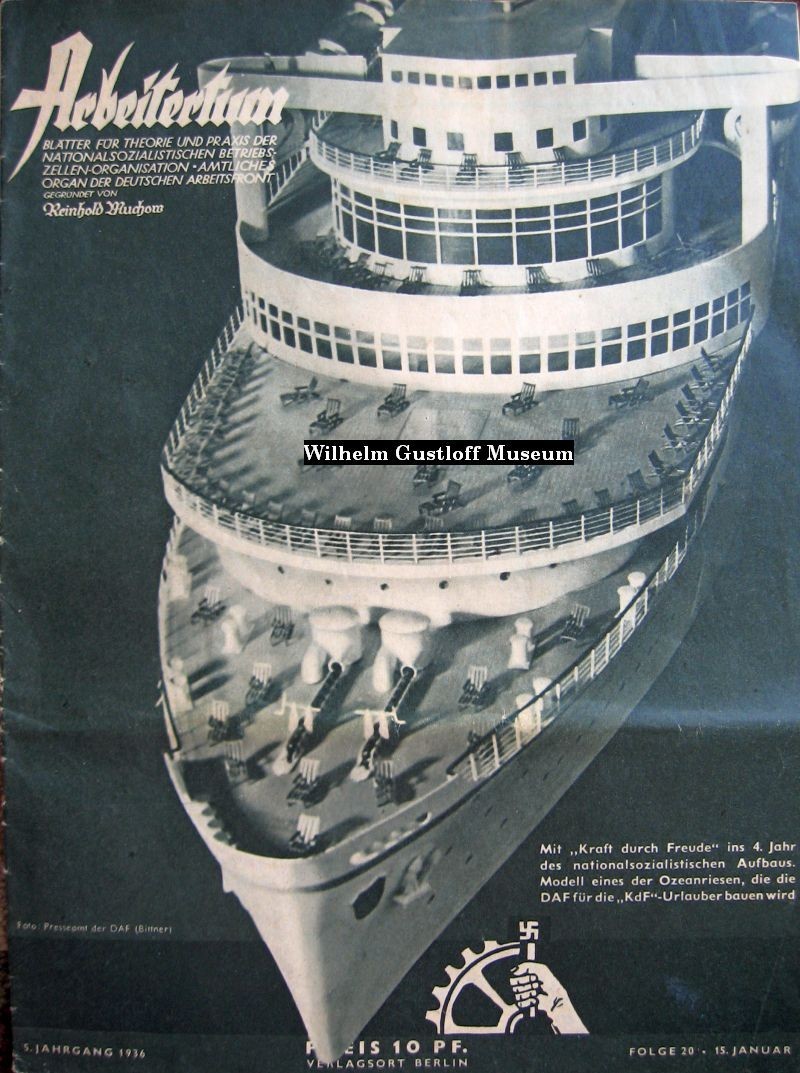
The new KdF ship had her first keel plate was laid August 4th, 1936. (Not August 1st as others have noted). The KdF, or Kraft durch Freude, was Germany's "Strength through Joy" program headed by Dr. Robert Ley under the parent organization the German Labor Front, or DAF. Its primary objective was to promote tourism and vacations within the Third Reich. In order to get people to join, the program offered low-cost cruises to exotic places for the German working class. The idea was that happy people work harder and it soon became the most effective program in the Third Reich. When first created, it employed ocean liners that would have otherwise been mothballed from the depression. These liners came from the Hamburg South-America Line, Hamburg-Amerika Line, and Norddeutshcer Lloyd companies. They included the Berlin, Der Deutsche, Milwaukee, Monte Olivia, Monte Rosa, Monte Sacrmeinto, St. Louis, Sierra Cordoba, and the Stuttgart. As Nazi Germany progressed and membership continued to grow, voyages for these ships were booked solid. Dr. Ley soon decided to build two liners specifically geared towards the KdF and its voyages. These ships would be known for their equal classes on board, open spaces, and every cabin would have an ocean view with no interior cabins. The first new flagship for the KdF, the "Adolf Hitler", had its name changed to the "Wilhelm Gustloff" in 1937. The second liner, the Robert Ley, was also under construction at the time. Ley's vision was to build 20 to 30 new ships for the program, but only these two were ever built. The earliest information available on the new KdF ships comes in the German working class magazine Arbeitertum on January 15th, 1936. (Left). The cover features the design of the new passenger liner. An additional view of what the stern of the new ship would look like was published in the June 1st, 1936 issue of Arbeitertum. "Model of the new 'Strength through Joy' ocean liner. The stepped decks hold large surfaces to allow sun to shine on the decks. On the 2nd deck (Boat Deck), the open hall of the cafe can be seen, while on the 3rd Deck (Promenade Deck) the pool is built." The Wilhelm Gustloff would look different after several changes and not have either of these stern features when completed. The lounges would become enclosed while the swimming pool was moved indoors towards the bow on E Deck. The full article translation can be viewed under the Arbeitertum page. Below is a sequence of photographs of the Wilhelm Gustloff taking shape at Blohm + Voss.
Construction of the new Kraft Durch Freude Flagship
M.S. Wilhelm Gustloff: August 4th, 1936
M.S. Wilhelm Gustloff: August 4th, 1936
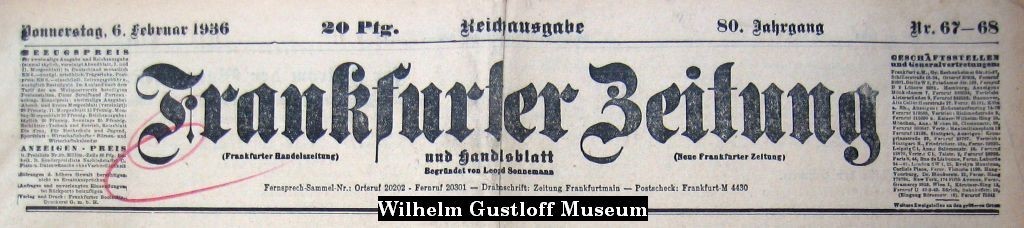
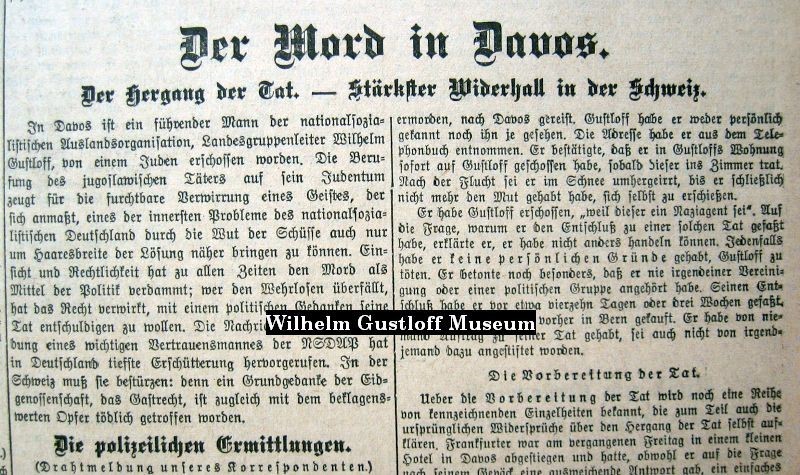
Frankfurt Newspaper: February 6th, 1936
The Murder in Davos: Course of action - The strongest response in Switzerland.
This newspaper has a few articles on the murder of Wilhelm Gustloff as well as information on the police investigation and how the Swiss press perceives the murder in an interior article.
The Murder in Davos: Course of action - The strongest response in Switzerland.
This newspaper has a few articles on the murder of Wilhelm Gustloff as well as information on the police investigation and how the Swiss press perceives the murder in an interior article.
Hamburg is alive with activity on Wednesday, May 5th, 1937. Hazy weather cannot dampen an event grand on both naval and propaganda perspective. Few are talking about anything other than the launching at Blohm + Voss Shipyard. Hitler and most of his senior party members are on hand for the official christening of the finest ship in the KdF fleet - the Wilhelm Gustloff. Thousands upon thousands gather as close as possible to the ceremony, or along the route that the Führer takes to the platform in shipyard #511. However, only those officially to receive an invitation from Robert Ley, head of the DAF and its sub-organization - the KdF, are given preferential viewing areas. The massive, yet still unfinished ship seems to even dwarf even the shipyard itself.
After numerous speeches by the top brass of the Nazi party, the widow Hedwig Gustloff breaks the traditional bottle on the bow to christen the ship. Huge boards drop on the bow quarters to reveal her late husband's name in Gothic letters. The massive ship slides into Hamburg harbor to the music of "Horst Wessel" and "Deutschland über Alles". Fascist salutes, wild cheers and swastika emblazoned flags fly freely around the ceremony.
From a naval perspective, the specifications of the Wilhelm Gustloff are not exceedingly groundbreaking. However, from a cruise ship standpoint, the ship is an impressive and unique achievement. When Blohm + Voss had been commissioned by the KdF to build the world's most advanced cruise ship (in January 1936), the key requirements had been:
- Large free decks. Free of obstructions; adequate space for all to lie down on deck; promote interaction between passengers and crew.
- Large bright halls with comfortable seating. No need to use dining halls which would be reserved for eating only.
- All passengers accommodated in outer cabins only. This would ensure that every guest would have an optimal view.
- All cabins would be created equivalent in size. Regardless of status - crew or passenger.
The Wilhelm Gustloff's specifications upon delivery were as follows:
After numerous speeches by the top brass of the Nazi party, the widow Hedwig Gustloff breaks the traditional bottle on the bow to christen the ship. Huge boards drop on the bow quarters to reveal her late husband's name in Gothic letters. The massive ship slides into Hamburg harbor to the music of "Horst Wessel" and "Deutschland über Alles". Fascist salutes, wild cheers and swastika emblazoned flags fly freely around the ceremony.
From a naval perspective, the specifications of the Wilhelm Gustloff are not exceedingly groundbreaking. However, from a cruise ship standpoint, the ship is an impressive and unique achievement. When Blohm + Voss had been commissioned by the KdF to build the world's most advanced cruise ship (in January 1936), the key requirements had been:
- Large free decks. Free of obstructions; adequate space for all to lie down on deck; promote interaction between passengers and crew.
- Large bright halls with comfortable seating. No need to use dining halls which would be reserved for eating only.
- All passengers accommodated in outer cabins only. This would ensure that every guest would have an optimal view.
- All cabins would be created equivalent in size. Regardless of status - crew or passenger.
The Wilhelm Gustloff's specifications upon delivery were as follows:
For Hitler, visibility of the Gustloff launching is an important propaganda tool not only within Germany, but also on the world stage. Overall, the Gustloff is deliberately used as a flagship symbol of Nazi objectives through the KdF organization. The KdF hopes for the following:
- Perception by workers that the Nazi government cares about them by providing very affordable travel opportunities aboard such a magnificent ship.
- Belief by German workers that this cruise ship was for them. It was designed to have one class only, contributing to the concept of racial unity among its people. (Volksgemeinschaft).
- Provide a means to reward consumers and the workforce beyond traditional consumer consumption.
- Provide aspiration and dreams for the German Volk. Allow workers to be happy with this achievement and that a potential opportunity for a trip aboard the Gustloff would help control personal desires until the realization of "living space" (Lebensraum).
- Continued promotion of travel as an acceptable means of developing culture and appreciation of Germany's standard of living.
- Demonstration of the power of the "New Germany". The gleaming ivory ship built with technological expertise, modern design and configuration is a symbol of German economic power and superior ideology to the rest of the world.
- As part of the Nazi's anti-Semitic agenda, a not-so-subtle reminder of "Jewish responsibility" for the death of the Nazi leader whose name marks the bows.
Ultimately, the true underlying agenda of the KdF is about increasing worker productivity (despite wage freezes) as Nazi Germany prepares for eventual war, defusing desire for American-style capitalism or Marxism, controlling consumer consumption that would come at the expense of rearmament, and ensuring "racial alignment" as Nazi Germany plans its world-leading ambitions.
- Perception by workers that the Nazi government cares about them by providing very affordable travel opportunities aboard such a magnificent ship.
- Belief by German workers that this cruise ship was for them. It was designed to have one class only, contributing to the concept of racial unity among its people. (Volksgemeinschaft).
- Provide a means to reward consumers and the workforce beyond traditional consumer consumption.
- Provide aspiration and dreams for the German Volk. Allow workers to be happy with this achievement and that a potential opportunity for a trip aboard the Gustloff would help control personal desires until the realization of "living space" (Lebensraum).
- Continued promotion of travel as an acceptable means of developing culture and appreciation of Germany's standard of living.
- Demonstration of the power of the "New Germany". The gleaming ivory ship built with technological expertise, modern design and configuration is a symbol of German economic power and superior ideology to the rest of the world.
- As part of the Nazi's anti-Semitic agenda, a not-so-subtle reminder of "Jewish responsibility" for the death of the Nazi leader whose name marks the bows.
Ultimately, the true underlying agenda of the KdF is about increasing worker productivity (despite wage freezes) as Nazi Germany prepares for eventual war, defusing desire for American-style capitalism or Marxism, controlling consumer consumption that would come at the expense of rearmament, and ensuring "racial alignment" as Nazi Germany plans its world-leading ambitions.
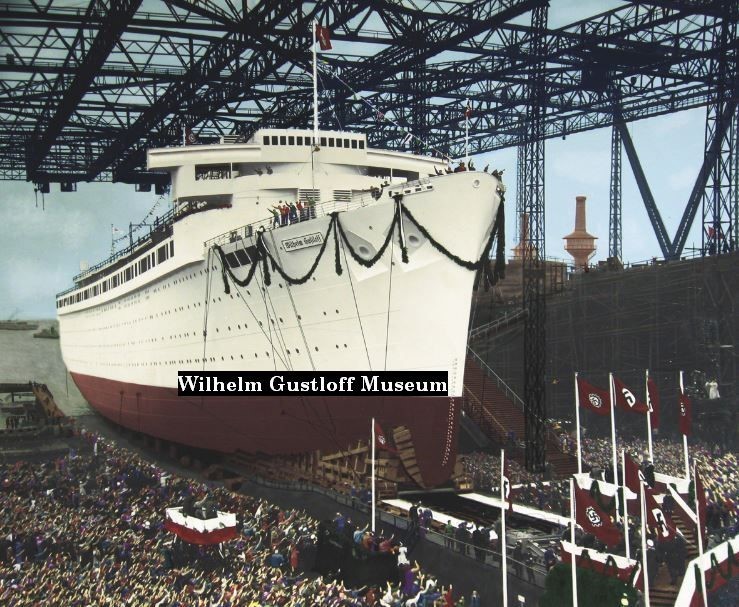
Left: Colorized by the curator, Blohm + Voss photo of the Wilhelm Gustloff on May 5th, 1937.
Launch photos below:
1: Adolf Hitler arrives at the launch of the Wilhelm Gustloff. To his left, Heinrich Himmler, to his right, Rudolf Blohm.
2: Frau Hedwig arrives at the launch of the ship to bear her late husband's name.
3: Adolf Hitler and Frau Hedwig meet before the launch.
4: Hitler walking toward the platform for his launch speech.
5: Approaching the Wilhelm Gustloff at Blohm + Voss. May 5th, 1937.
6: Approaching the Wilhelm Gustloff at Blohm + Voss. May 5th, 1937.
7: A spectator in the crowd captures an image of Adolf Hitler saluting as he makes his way to the grandstand for the launch ceremony.
8: Aerial view of the crowd and the Wilhelm Gustloff at Blohm + Voss.
9: Dr. Robert Ley gives his speech at the launch of the Wilhelm Gustloff. Excerpt below.
10: Frau Hedwig smashes the bottle of champagne on the bow, christening the new KdF flagship.
11: Frau Hedwig smashes the bottle of champagne on the bow, christening the new KdF flagship.
12: With her new name plate dropping down from the bow, the Gustloff begins to slide down her ramp into the Elbe River.
13 - 17: Set of launch photographs taken by a guest in the crowd at ground level next to the ship.
18: The Wilhelm Gustloff sliding down the slipway.
19: The Wilhelm Gustloff comes in contact with water for the first time as thousands cheer on.
20 - 21: View of the Wilhelm Gustloff being launched from the Elbe River.
22: View of the Wilhelm Gustloff being launched from the Elbe River.
23 - 24: The Wilhelm Gustloff resting in the Elbe.
Launch photos below:
1: Adolf Hitler arrives at the launch of the Wilhelm Gustloff. To his left, Heinrich Himmler, to his right, Rudolf Blohm.
2: Frau Hedwig arrives at the launch of the ship to bear her late husband's name.
3: Adolf Hitler and Frau Hedwig meet before the launch.
4: Hitler walking toward the platform for his launch speech.
5: Approaching the Wilhelm Gustloff at Blohm + Voss. May 5th, 1937.
6: Approaching the Wilhelm Gustloff at Blohm + Voss. May 5th, 1937.
7: A spectator in the crowd captures an image of Adolf Hitler saluting as he makes his way to the grandstand for the launch ceremony.
8: Aerial view of the crowd and the Wilhelm Gustloff at Blohm + Voss.
9: Dr. Robert Ley gives his speech at the launch of the Wilhelm Gustloff. Excerpt below.
10: Frau Hedwig smashes the bottle of champagne on the bow, christening the new KdF flagship.
11: Frau Hedwig smashes the bottle of champagne on the bow, christening the new KdF flagship.
12: With her new name plate dropping down from the bow, the Gustloff begins to slide down her ramp into the Elbe River.
13 - 17: Set of launch photographs taken by a guest in the crowd at ground level next to the ship.
18: The Wilhelm Gustloff sliding down the slipway.
19: The Wilhelm Gustloff comes in contact with water for the first time as thousands cheer on.
20 - 21: View of the Wilhelm Gustloff being launched from the Elbe River.
22: View of the Wilhelm Gustloff being launched from the Elbe River.
23 - 24: The Wilhelm Gustloff resting in the Elbe.
Dr. Robert Ley gives his speech before the launch,"We want to live a happy life," exclaims Dr. Ley as he draws from the cheers of tens of thousands. "Not just of joy but because of our ability to draw from strength. Our socialism lies in the affirmation of this life. We also affirm the concerns we can not lose, but we want him (Hitler) to give strength to overcome these concerns, we never surrender again! The highest of what we want, which is Germany's eternity!" At the end of his speech, Dr. Ley announced the name of the person to be baptized on the ship: "Wilhelm Gustloff".
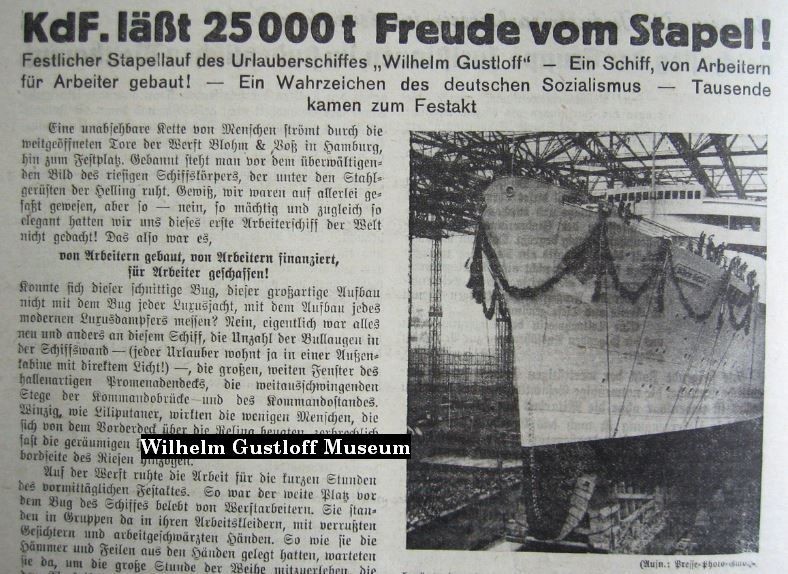
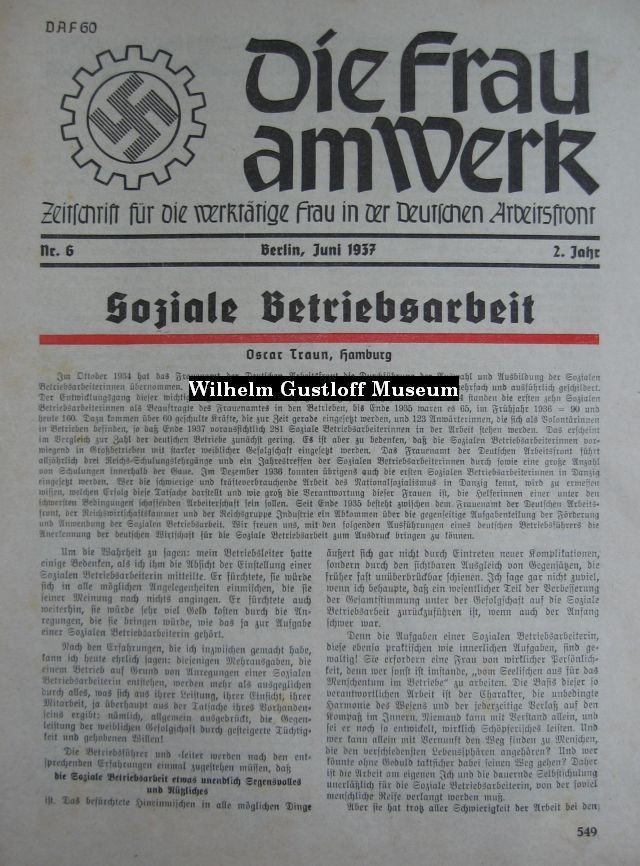
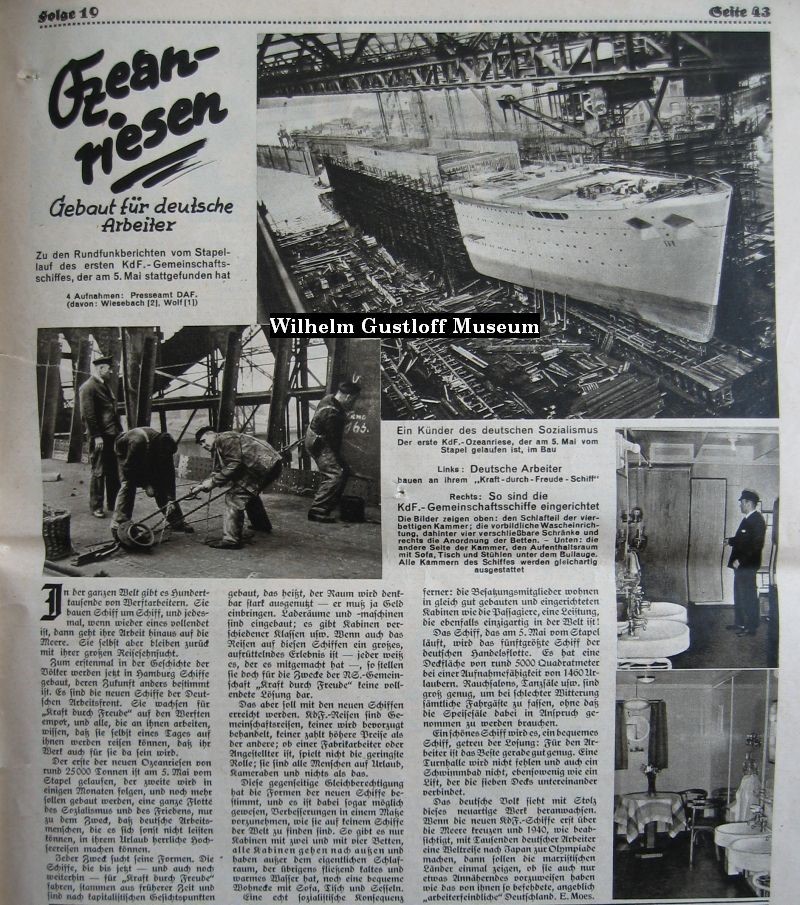
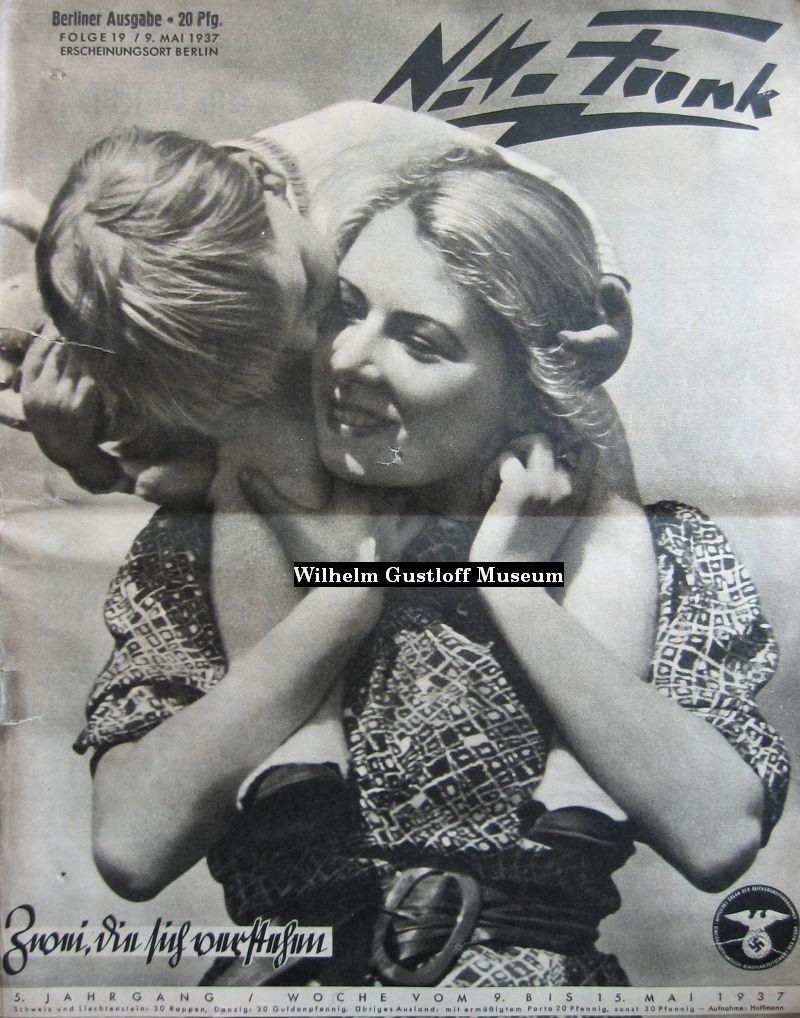
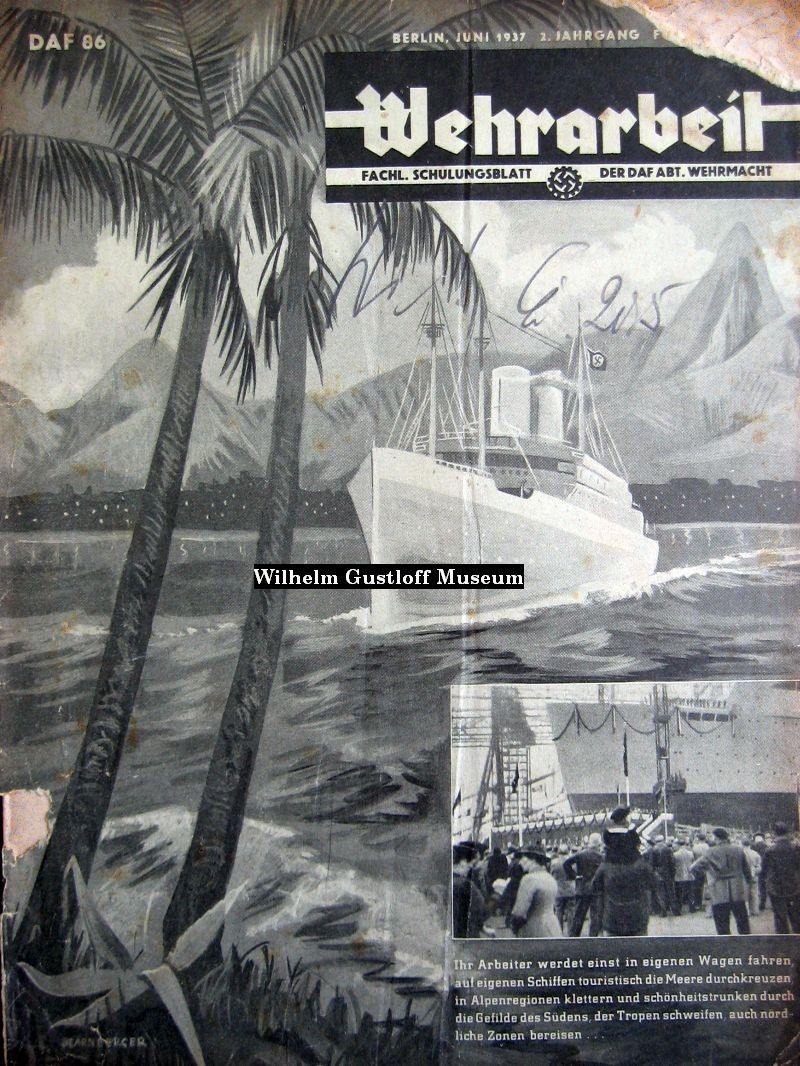
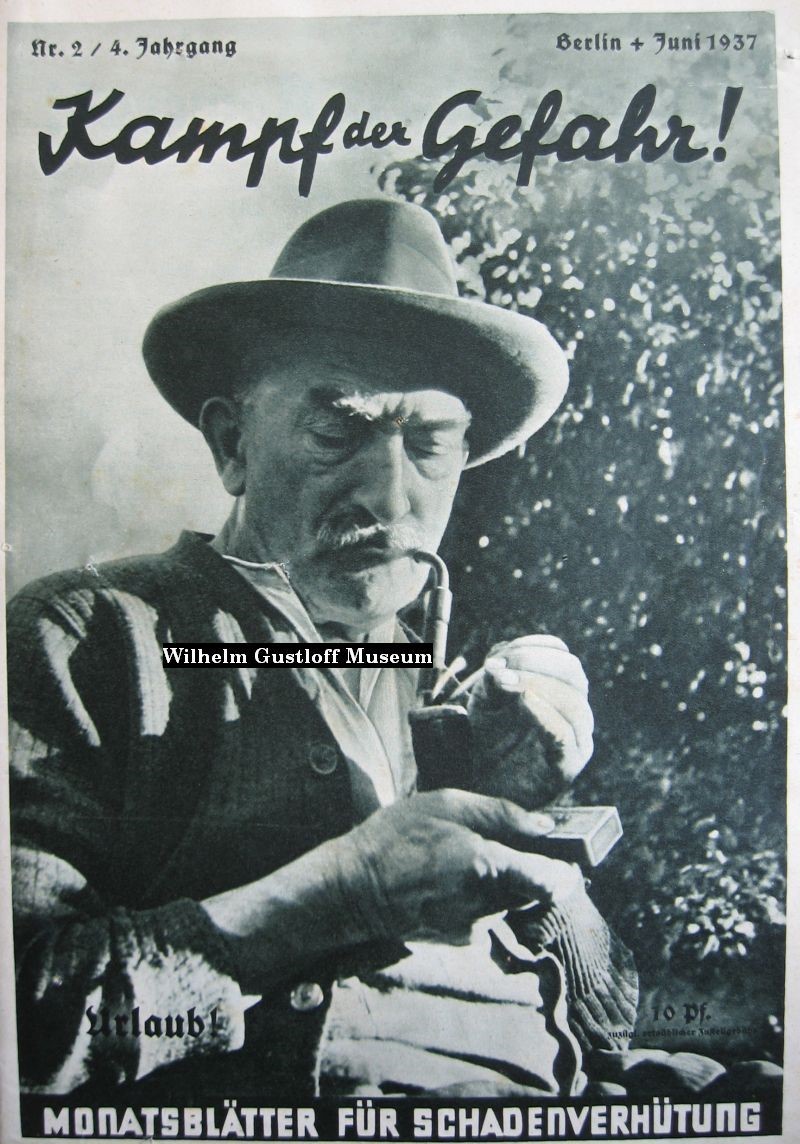
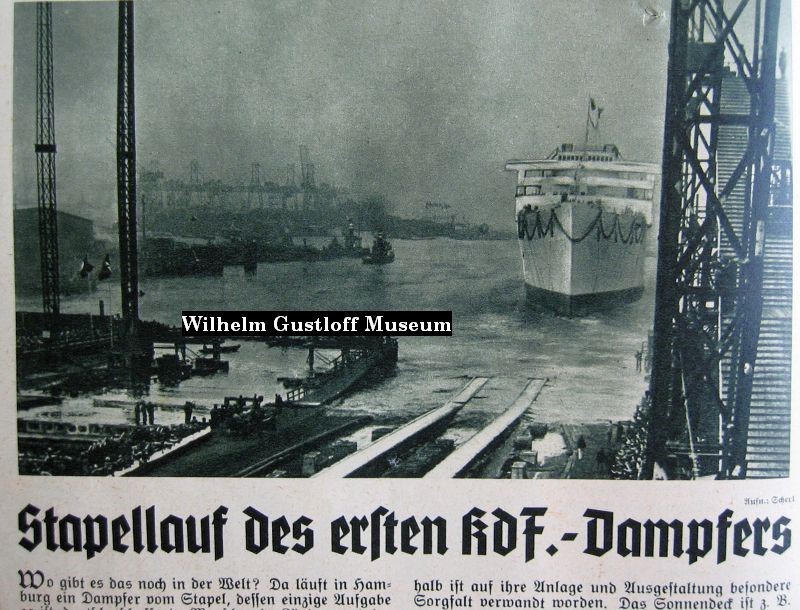
Two spacious dining rooms are arranged in such a way that all passengers can take their meals in two sittings. The lounges proper offer room for all passengers, without using the dining rooms outside the mealtimes. A public address system for announcements as well as music transmissions and radio reception plus a movie projector are welcome additions. But most of the time the vacationers, especially on sunny days for sure, will be on deck. Special attention was put into their design and equipment. The Sun Deck is free of any structure. All decks together have a surface of 5,000 square meters. Apart from the Sports Deck you can find two Promenade Decks. A walk three times around the Lower Promenade Deck covers approximately one kilometer. A gym on the Sun Deck offers many opportunities for the sportsman and the gymnast. The indoor pool on the lower deck contains a swimming pool measuring 11 meters in length and 5 meters in width.
The safety equipment onboard is excellent. 22 lifeboats, including 20 with diesel engines are available, and two of these boats are equipped with complete radio equipment and searchlights. Against dangers the ship has a double hull and is divided into 13 watertight bulkheads. The upper part of the steamer is covered with fireproof walls against the danger of a fire; the remaining walls have fire-retarding paint. Two doctors and a dentist are permanently on board. Their offices are perfectly appointed. The first German KdF vacation ship, that carries the name of the assassinated country group leader, will be operational in 1938. After that date the German merchant marine will have the most modern passenger ship in the world. However the ship, and this is important, does not cruise the oceans to make money for someone, this ship carries German workers onward and proclaims German socialism in every port.
The safety equipment onboard is excellent. 22 lifeboats, including 20 with diesel engines are available, and two of these boats are equipped with complete radio equipment and searchlights. Against dangers the ship has a double hull and is divided into 13 watertight bulkheads. The upper part of the steamer is covered with fireproof walls against the danger of a fire; the remaining walls have fire-retarding paint. Two doctors and a dentist are permanently on board. Their offices are perfectly appointed. The first German KdF vacation ship, that carries the name of the assassinated country group leader, will be operational in 1938. After that date the German merchant marine will have the most modern passenger ship in the world. However the ship, and this is important, does not cruise the oceans to make money for someone, this ship carries German workers onward and proclaims German socialism in every port.
Outfitting the KdF Flagship Wilhelm Gustloff
May 1937 - March 1938
May 1937 - March 1938
It will be over 10 months after the impressive launching ceremony before the Wilhelm Gustloff is actually ready to be tested in March of 1938 as a cruise ship to serve all classes of the German Volk. During this time, the interior of the ship is prepared to offer future passengers an unforgettable cruise experience such as impressive lounges, music salons, a swimming pool and several taprooms (bars). In its history books, Blohm + Voss refer to the Gustloff's interior as "simple elegance". From the more visible exterior, the funnel (to carry the distinctive logo of the KdF), 3 main anchors, bridge, compass platform, and 22 lifeboats are added.
1: Soon after the Wilhelm Gustloff reaches the water, workers begin transforming her.
2: Soon after the Wilhelm Gustloff reaches the water, workers begin transforming her.
3: Bridge windows are among the new items added to the hull.
4: Workers add a coat of white paint around the Wilhelm Gustloff's new stern name.
5: Work continues to progress on the Gustloff.
6: Work continues to progress on the Gustloff.
7: Work continues to progress on the Gustloff.
8: The Gustloff enters dry dock to begin work around her waterline.
9: New lifeboat davits are added along the Upper Promenade Deck.
10: One of the Wilhelm Gustloff's new lifeboats arrive at the docks.
11: Workers leave the Gustloff after a hard day's work.
12: The Blohm + Voss design for her funnel.
13: Workers stand atop her funnel which now sports the KdF logo.
14: Workers take a break on the dock along side the towering bow of the new liner.
15: The Wilhelm Gustloff's twin propellers are added to her stern.
2: Soon after the Wilhelm Gustloff reaches the water, workers begin transforming her.
3: Bridge windows are among the new items added to the hull.
4: Workers add a coat of white paint around the Wilhelm Gustloff's new stern name.
5: Work continues to progress on the Gustloff.
6: Work continues to progress on the Gustloff.
7: Work continues to progress on the Gustloff.
8: The Gustloff enters dry dock to begin work around her waterline.
9: New lifeboat davits are added along the Upper Promenade Deck.
10: One of the Wilhelm Gustloff's new lifeboats arrive at the docks.
11: Workers leave the Gustloff after a hard day's work.
12: The Blohm + Voss design for her funnel.
13: Workers stand atop her funnel which now sports the KdF logo.
14: Workers take a break on the dock along side the towering bow of the new liner.
15: The Wilhelm Gustloff's twin propellers are added to her stern.
16: The Wilhelm Gustloff receiveing her fresh coat of paint. Note the scaffolding on the sides.
17: Photo moved to its correct location.
18: The new Wilhelm Gustloff name on her bow in dry dock.
19: The Wilhelm Gustloff's 22 lifeboats undo testing for the first time.
20: Continuing to add lifeboats on her starboard side.
21: The exterior of the Wilhelm Gustloff is nearing completion.
22: Workers add controls and machinery to her engine room.
23: Workers begin the long process of adding tile to her swimming pool on E Deck.
24: The Lower Promenade Deck under construction.
25: One of 3 bells on the Wilhelm Gustloff. This one is on her forward bow.
26: Turning steel into the Great Hall.
27: Working on what will either become the Middle Hall or German Hall.
28: Construction on building one of her writing rooms.
29: Adding decking to the Lower Promenade Deck.
30: The ship wasn't even finished, yet the KdF was promoting her as much as they could.
17: Photo moved to its correct location.
18: The new Wilhelm Gustloff name on her bow in dry dock.
19: The Wilhelm Gustloff's 22 lifeboats undo testing for the first time.
20: Continuing to add lifeboats on her starboard side.
21: The exterior of the Wilhelm Gustloff is nearing completion.
22: Workers add controls and machinery to her engine room.
23: Workers begin the long process of adding tile to her swimming pool on E Deck.
24: The Lower Promenade Deck under construction.
25: One of 3 bells on the Wilhelm Gustloff. This one is on her forward bow.
26: Turning steel into the Great Hall.
27: Working on what will either become the Middle Hall or German Hall.
28: Construction on building one of her writing rooms.
29: Adding decking to the Lower Promenade Deck.
30: The ship wasn't even finished, yet the KdF was promoting her as much as they could.
As the Wilhelm Gustloff gets her final exterior touches, there was already speculation among foreign news agencies surrounding the Gustloff's possible military use before she was even completed. "See the Reich 'Joy Cruise' ships as aircraft carriers? According to a foreign shipping expert quoted by Reynolds Sunday News (England), aerial photographs of Germany's 'Strength through Joy' workers vacation cruise ships, have aroused considerable speculation as to whether these craft with their long upper deck, obstructed by only a funnel, could be quickly converted into aircraft carriers. The Wilhelm Gustloff, forerunner of a fleet of 20 similar ships of 25,000 gross tons, is about 700 feet long and has a deck area of 53,800 square feet. Claimed to be larger than any vessels of this size. Modified for service as an airfract carrier, the vessel could accommodate 35 aircraft. The photo shows the Wilhelm Gustloff after launching in Germany in March, 1938."
On March 15th, 1938, the Wilhelm Gustloff is finally ready to be put to sea in its capacity as the most advanced cruise ship in the world. However, this is not to be an official trip. It is a two-day test run in the North Sea. Filled to capacity with primarily employees from the shipbuilding company Blohm + Voss, the ship encounters rough and stormy seas. Despite the inclement weather and some reported seasickness, many passengers are reported to have enjoyed more celebrating than sleeping during the two nights of adventure. Captain Carl Lübbe is in command.
On March 15th, 1938, the Wilhelm Gustloff is finally ready to be put to sea in its capacity as the most advanced cruise ship in the world. However, this is not to be an official trip. It is a two-day test run in the North Sea. Filled to capacity with primarily employees from the shipbuilding company Blohm + Voss, the ship encounters rough and stormy seas. Despite the inclement weather and some reported seasickness, many passengers are reported to have enjoyed more celebrating than sleeping during the two nights of adventure. Captain Carl Lübbe is in command.
Unofficial Maiden Voyage of the M.S. Wilhelm Gustloff
March 24th to March 26th, 1938
March 24th to March 26th, 1938
Only the most carefully screened passengers are selected for the Wilhelm Gustloff's maiden voyage, or Jungfernreise. This, in fact, will be considered her unofficial maiden voyage because passengers are selected more for propaganda rather than pleasure. Set to leave on Thursday, March 24th, 1938, eager passengers begin boarding the day prior on March 23rd.
With a touch of irony, most of the passengers are not German (at least not officially by nationality at this point). Over two-thirds of the passenger list is compromised of Austrians, whose country would soon vote in a plebiscite on whether to be annexed by Germany. Although the plebiscite is a mere formality (Hitler had already announced on March 12th that Austria was to be annexed into Germany), the Nazis do not pass up an opportunity to cultivate powerful propaganda opportunities.
The rest of the passenger complement seems to only reinforce the propaganda - 300 girls selected specifically from the BDM, or Bund Deutscher Mädel (Federation of German Girls) and 165 journalists join the Austrians and the crew.
Captain Carl Lübbe directs the ship out to the North Sea for a three day cruise. Journalists are treated to detailed information and tours of the ship, courtesy of KdF guide Paul Wulff. Halfway through the cruise, a flattering telegram arrives from the Führer directed to the Austrians on board. Even at sea the propaganda arrives!
The cruise is considered a tremendous success, with its many participants ready to bring the news back to Austria of this awe-inspiring symbol of German engineering and unity.
With a touch of irony, most of the passengers are not German (at least not officially by nationality at this point). Over two-thirds of the passenger list is compromised of Austrians, whose country would soon vote in a plebiscite on whether to be annexed by Germany. Although the plebiscite is a mere formality (Hitler had already announced on March 12th that Austria was to be annexed into Germany), the Nazis do not pass up an opportunity to cultivate powerful propaganda opportunities.
The rest of the passenger complement seems to only reinforce the propaganda - 300 girls selected specifically from the BDM, or Bund Deutscher Mädel (Federation of German Girls) and 165 journalists join the Austrians and the crew.
Captain Carl Lübbe directs the ship out to the North Sea for a three day cruise. Journalists are treated to detailed information and tours of the ship, courtesy of KdF guide Paul Wulff. Halfway through the cruise, a flattering telegram arrives from the Führer directed to the Austrians on board. Even at sea the propaganda arrives!
The cruise is considered a tremendous success, with its many participants ready to bring the news back to Austria of this awe-inspiring symbol of German engineering and unity.
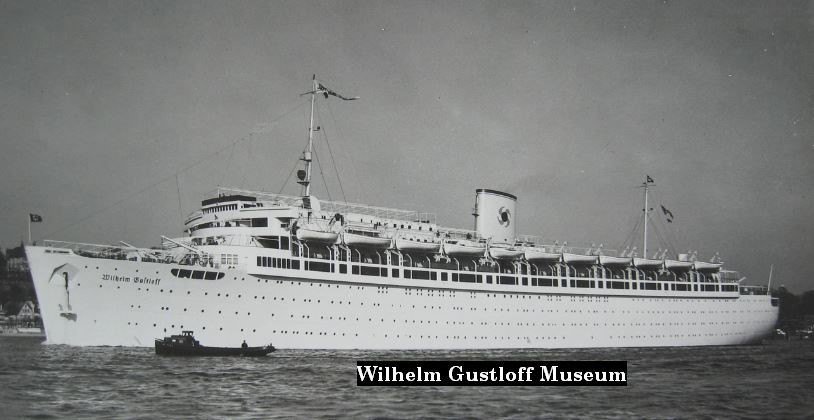
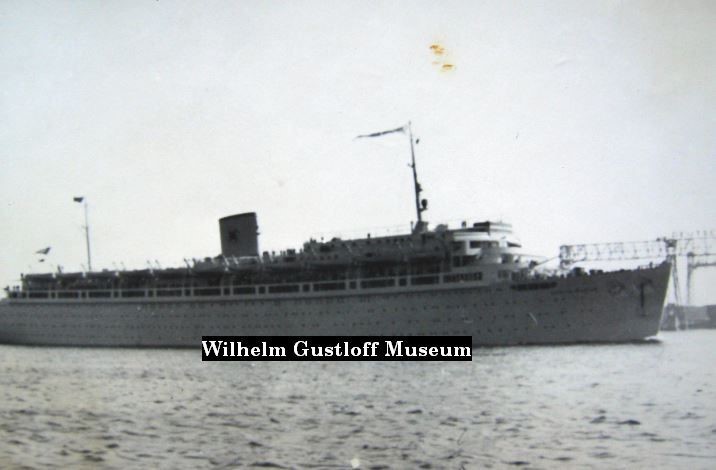
Left:The newly finished flagship of the KdF fleet - the M.S. Wilhelm Gustloff.
Right: Dated March 15th, 1938, this photograph shows the Wilhelm Gustloff steaming out of Hamburg harbor on her 24 hour test run in the North Sea. Her first voyage!
Below: Telegram receipt from March 17th, 1938.
Right: Dated March 15th, 1938, this photograph shows the Wilhelm Gustloff steaming out of Hamburg harbor on her 24 hour test run in the North Sea. Her first voyage!
Below: Telegram receipt from March 17th, 1938.
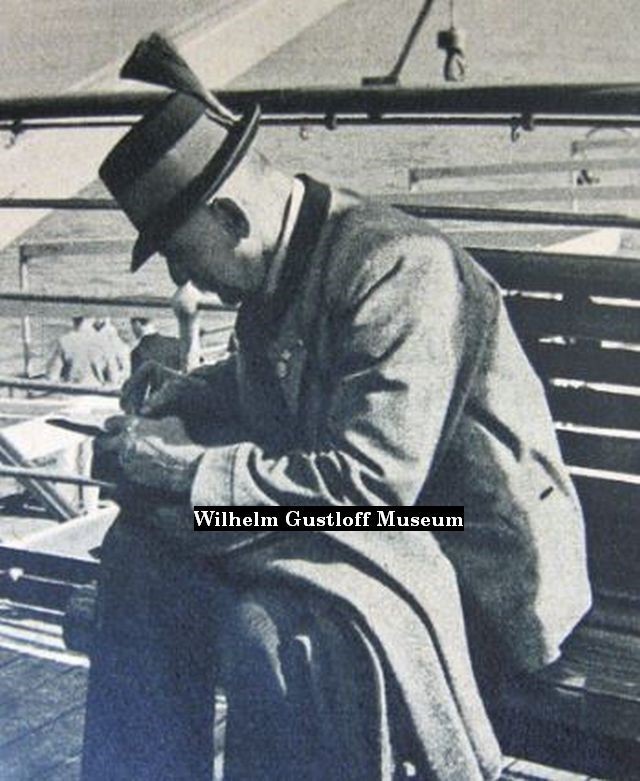
Above Left: On board postal cancellation stamp for March 26th, 1938.
Above Right: One of the thousands of Austrians who participated in the unoffical maiden voyage trip to the North Sea.
Below: A unique set of photographs taken aboard the Wilhelm Gustloff on her unofficial maiden voyage. Part of the "1,000 Austrian Workmates visit Hansestadt Hamburg with the KdF. I. K.d.F. Voyage for March 23rd to March 31st, 1938. The last photo is a unique press photograph taken in the ship's dining room with Austrians eating on the first day of the trip - March 24th.
Above Right: One of the thousands of Austrians who participated in the unoffical maiden voyage trip to the North Sea.
Below: A unique set of photographs taken aboard the Wilhelm Gustloff on her unofficial maiden voyage. Part of the "1,000 Austrian Workmates visit Hansestadt Hamburg with the KdF. I. K.d.F. Voyage for March 23rd to March 31st, 1938. The last photo is a unique press photograph taken in the ship's dining room with Austrians eating on the first day of the trip - March 24th.
Pre-Maiden Voyage of the M.S. Wilhelm Gustloff
March 29th to March 31st, 1938
Adolf Hitler visits the Wilhelm Gustloff
March 29th to March 31st, 1938
Adolf Hitler visits the Wilhelm Gustloff
On March 29th, 1938, Adolf Hitler made his first and only appearance on board the Wilhelm Gustloff. What is known of his visit was captured in three photographs and a newspaper reporter quoting that he had "demonstrated that the crew's spaces are as beautiful as the cabins." After Hitler disembarked, boarding for passengers began at noon and ran until 2:00. Nothing more is known about the destination for this trip, but it is specifically for Blohm + Voss' employees and their families. A menu from March 31st still does not present any daily agenda.
Right: Ticket book cover and ticket for this voyage. Below Left: Captain Carl Lübbe escorts Hitler past the Wilhelm Gustloff crew members lined up on the Lower Promenade Deck. Below Middle: Hitler tours the Smoking Room of the Wilhelm Gustloff. Below Right: Hitler with Dr. Bodo Lafferentz, Leader for the KdF, on his right and Dr. Robert Ley, Head of the DAF, next to him in the Great Hall on board.
Right: Ticket book cover and ticket for this voyage. Below Left: Captain Carl Lübbe escorts Hitler past the Wilhelm Gustloff crew members lined up on the Lower Promenade Deck. Below Middle: Hitler tours the Smoking Room of the Wilhelm Gustloff. Below Right: Hitler with Dr. Bodo Lafferentz, Leader for the KdF, on his right and Dr. Robert Ley, Head of the DAF, next to him in the Great Hall on board.
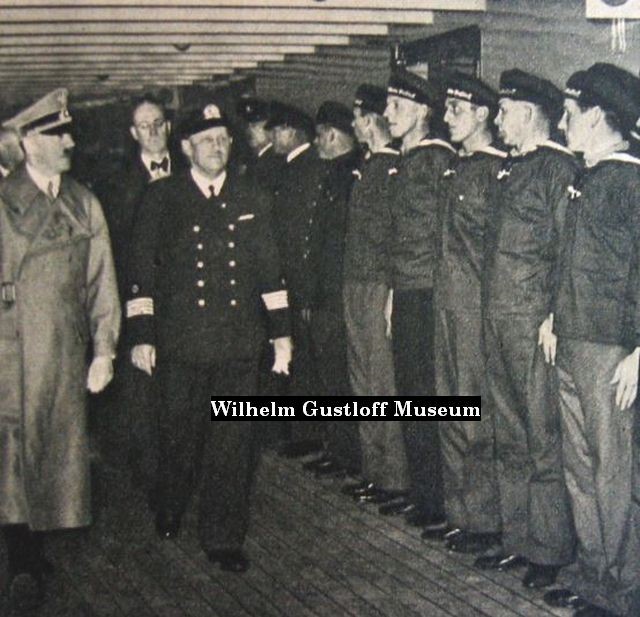
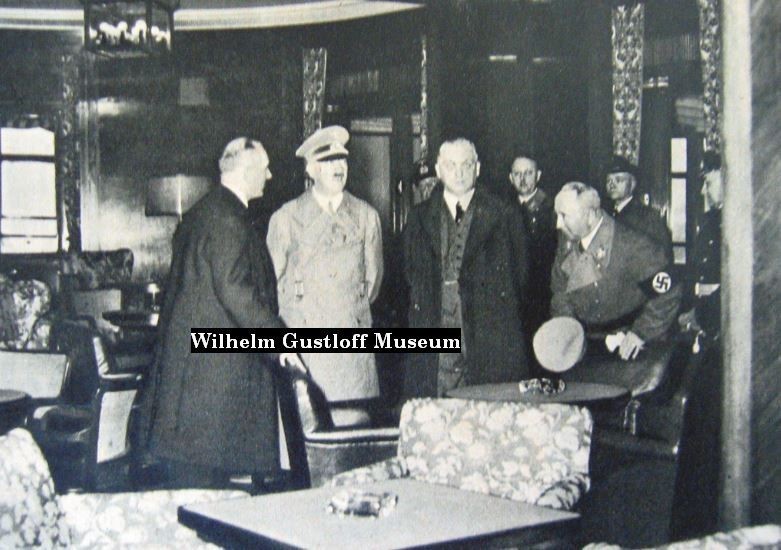
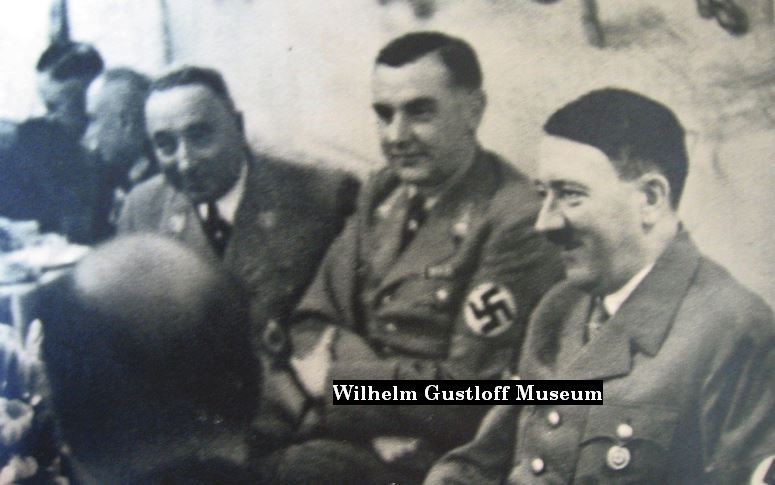
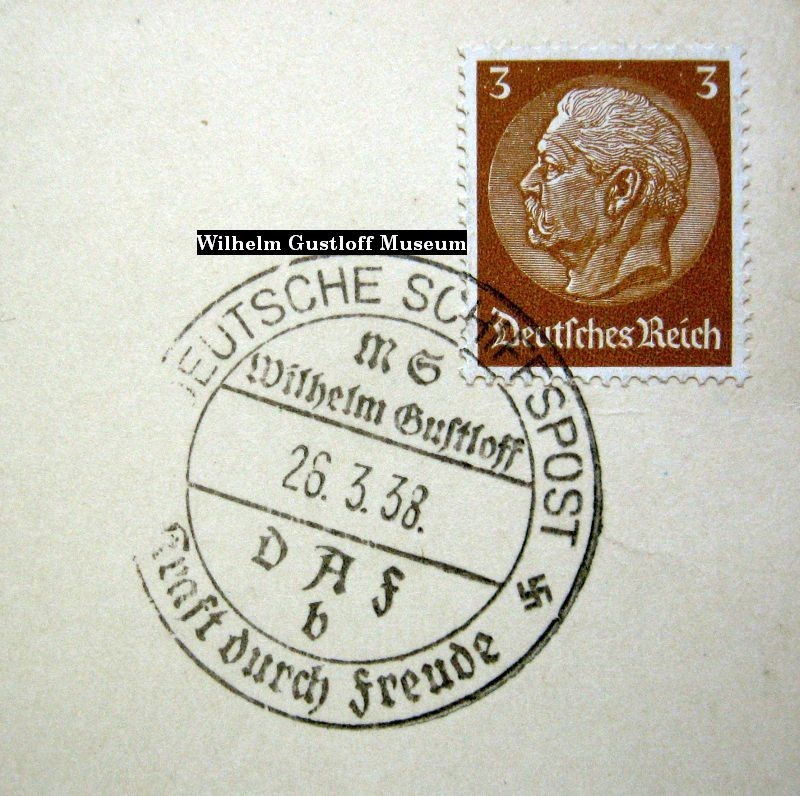
Above: The scene of the shooting -
Wilhelm Gustloff's study.
Wilhelm Gustloff's study.
Crew of the M.S. Wilhelm Gustloff
March 11th to 14th, 1938
March 11th to 14th, 1938
In the days before the Wilhelm Gustloff sets sail on her test run, her 417 crew members arrive at the liner to settle into their cabins as sailors on the new flagship of the KdF fleet.
One of these sailors was Otto Ullrich. Born in Chrvalkovice, Czech Republic on February 4th, 1898, he began his sailing career on February 25th, 1922 aboard the German ship Emden. For the next 16 years, he would serve on the following ships:
Emden / North Sea Harbor - February 25th to March 30th, 1922
Hamfelde RWNG at Hamburg Hafen - May 9th-11th, 1922
Sestri - May 5th to July 24th, 1922
Bilbao - August 10th to November 4th, 1922
La Coruna - December 18th, 1922 to March 7th, 1923
Argentina - March 22nd, 1923 to June 10th, 1924
Santa Theresa - July 29th to November 23rd, 1924
Tenerife - December 16th, 1924 to May 22nd, 1925
La Coruna - May 28th, 1925 to January 6th, 1927
Tenerife - November 22nd, 1927 to March 2nd, 1928
Monte Sarmiento - June 8th to August 29th, 1928
Santa Fe - September 17th, 1928 to March 13th, 1929
Espana - May 25th to August 10th, 1929
Rio de Janeiro - September 9th to December 19th, 1929
Villagarcia - February 3rd to April 23rd, 1930
Cap Polonio - April 25th to December 10th, 1930
Vigo - March 2nd to August 1st, 1931
Santa Fe - October 27th, 1931 to November 9th, 1932
Monte Pascoal - October 26th, 1933 to March 25th, 1934
Monte Sarmiento - September 27th, 1934 to January 25th, 1938
Wilhelm Gustloff - March 11th, 1938 to August 17th, 1939
One of these sailors was Otto Ullrich. Born in Chrvalkovice, Czech Republic on February 4th, 1898, he began his sailing career on February 25th, 1922 aboard the German ship Emden. For the next 16 years, he would serve on the following ships:
Emden / North Sea Harbor - February 25th to March 30th, 1922
Hamfelde RWNG at Hamburg Hafen - May 9th-11th, 1922
Sestri - May 5th to July 24th, 1922
Bilbao - August 10th to November 4th, 1922
La Coruna - December 18th, 1922 to March 7th, 1923
Argentina - March 22nd, 1923 to June 10th, 1924
Santa Theresa - July 29th to November 23rd, 1924
Tenerife - December 16th, 1924 to May 22nd, 1925
La Coruna - May 28th, 1925 to January 6th, 1927
Tenerife - November 22nd, 1927 to March 2nd, 1928
Monte Sarmiento - June 8th to August 29th, 1928
Santa Fe - September 17th, 1928 to March 13th, 1929
Espana - May 25th to August 10th, 1929
Rio de Janeiro - September 9th to December 19th, 1929
Villagarcia - February 3rd to April 23rd, 1930
Cap Polonio - April 25th to December 10th, 1930
Vigo - March 2nd to August 1st, 1931
Santa Fe - October 27th, 1931 to November 9th, 1932
Monte Pascoal - October 26th, 1933 to March 25th, 1934
Monte Sarmiento - September 27th, 1934 to January 25th, 1938
Wilhelm Gustloff - March 11th, 1938 to August 17th, 1939
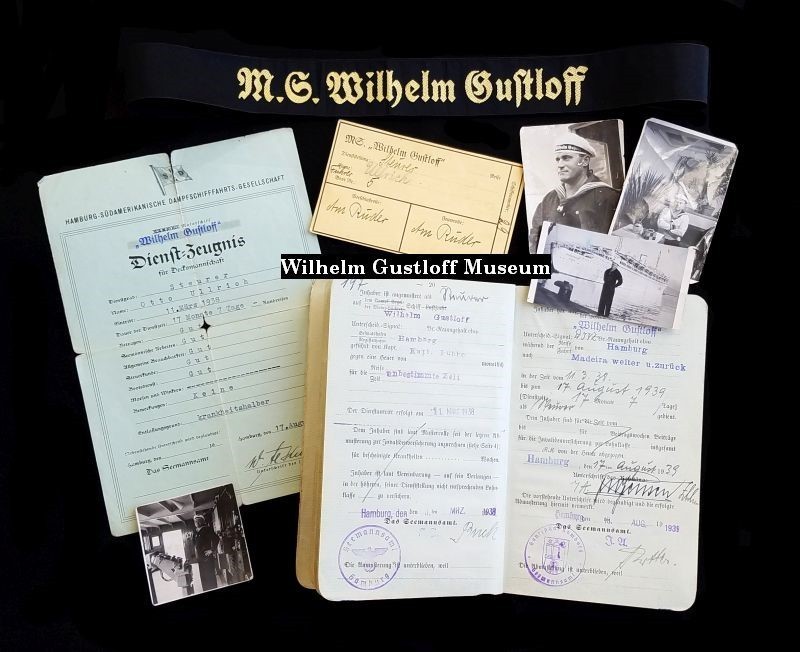
Until this amazing collection surfaced in 2017, the crew version of the Wilhelm Gustloff cap tally was not known to have survived the war. It was believed that the KdF program collected these tallies back after a sailor's time was completed on a ship. Whether Otto was allowed to keep his tally or whether he snuck it off the ship is not known, but it is the first crew mutzenband known to exist. Not only did the tally survive, but his collection included photos of him wearing this very tally in his cabin aboard and on the bridge along with his crew lifeboat card - which was his position aboard the Gustloff. Another amazing feat is that he served aboard the Gustloff from March 11th, 1938 all the way until August 17th, 1939 - missing only her final voyage! His discharge sheet states he missed the final voyage due to illness. It is not known what happened to him once World War II began, but I am glad that I can share his story with the world. Otto's collection below:
Photographs:
#1 - 3: Otto's Czech Republic Passport.
#4 - 7: Otto's first German Reich Sailor's Discharge Book. Issued in Emden, March 11th, 1922. Ends with La Coruna in 1927.
#8 - 10: Otto's second German Reich Sailor's Discharge Book. Issued in Hamburg, January 7th, 1927. Ends with Santa Fe in 1932.
#11 - 12: Otto's third German Reich Sailor's Discharge Book. Issued in Hamburg, March 1st, 1932. Ends with the Wilhelm Gustloff - August 17th, 1939. Also has Captain Petersen's signature.
#13: Otto's cap tally and passport with discharge books.
#14: Otto's Individual File for his time aboard the Monte Sarmiento in Argentina. Features his photograph, personal information, and finger prints. 1931
#15: Otto's Individual File for his time aboard the Vigo. Features his photograph, personal information, and finger prints. 1927
#16: Otto's Service Testimony papers with the time aboard each ship, evaluation, and why he left. Many are of the personal wish to transfer. Has each captain's signature as well.
#17: Otto on the bridge with the telegraph of one of his earlier assignments.
#18: Otto with other crew members aboard another earlier ship.
#19: Otto taking a break and traveling as a passenger (far right) aboard the Cap Norte. No date given.
#20 - 21: Homeland permit from the City Council of Neutitschein - Hereby confirmed that the named person in this city has the right of residence paper. On the back are two stamps dated from his time on the Gustloff: Voting certificate issued for the Reichstag election, December 4th, 1938. Genua, November 26th, 1938. Second stamp: He participated in the Reichstag Election on November 1938 aboard the liner Stuttgart in Genoa. Signed by the polling station representative.
#22: Certificate of Qualification as Lifeboat Man to Sailor Otto Ullrich. 1927.
#23: Work Order for Otto Ullrich issued by the Hamburg Amerike Linie in 1922.
#24: Otto's maritime insurance card issued by See-Berufsgenossenschaft. 1922.
#25: Otto's Service Testimony paper for his time aboard the Wilhelm Gustloff. March 11th, 1938 to August 17th, 1939. Listed as Steurer, Reason for leaving was illness. Signed by W. Huiepe?
#26 - 27: Otto's Lifeboat Crew Member card - Service as Steurer, Guide for Lifeboot No. 5, Role at the helm, Ship Number 29. Back information is on what to do in an emergency.
#28: Otto wearing his cap tally on the port bridge wing of the Wilhelm Gustloff.
#29: Otto in uniform with the Wilhelm Gustloff in Genoa, Italy.
#30: Otto at the helm of the Wilhelm Gustloff in uniform.
#31: Otto with the bell of the Wilhelm Gustloff on her bow.
#32: Otto in his crew cabin aboard the Wilhelm Gustloff. Note the personal touches with the plants, as well as a bottle of Moscato Passito. (I would love to find a bottle of this to accent the collection). It is also just amazing to think that the cap tally he is wearing in each of these photographs is the same one that followed him through his entire Gustloff career and is the same one I can hold in my hands. The stories it could tell!
Photographs:
#1 - 3: Otto's Czech Republic Passport.
#4 - 7: Otto's first German Reich Sailor's Discharge Book. Issued in Emden, March 11th, 1922. Ends with La Coruna in 1927.
#8 - 10: Otto's second German Reich Sailor's Discharge Book. Issued in Hamburg, January 7th, 1927. Ends with Santa Fe in 1932.
#11 - 12: Otto's third German Reich Sailor's Discharge Book. Issued in Hamburg, March 1st, 1932. Ends with the Wilhelm Gustloff - August 17th, 1939. Also has Captain Petersen's signature.
#13: Otto's cap tally and passport with discharge books.
#14: Otto's Individual File for his time aboard the Monte Sarmiento in Argentina. Features his photograph, personal information, and finger prints. 1931
#15: Otto's Individual File for his time aboard the Vigo. Features his photograph, personal information, and finger prints. 1927
#16: Otto's Service Testimony papers with the time aboard each ship, evaluation, and why he left. Many are of the personal wish to transfer. Has each captain's signature as well.
#17: Otto on the bridge with the telegraph of one of his earlier assignments.
#18: Otto with other crew members aboard another earlier ship.
#19: Otto taking a break and traveling as a passenger (far right) aboard the Cap Norte. No date given.
#20 - 21: Homeland permit from the City Council of Neutitschein - Hereby confirmed that the named person in this city has the right of residence paper. On the back are two stamps dated from his time on the Gustloff: Voting certificate issued for the Reichstag election, December 4th, 1938. Genua, November 26th, 1938. Second stamp: He participated in the Reichstag Election on November 1938 aboard the liner Stuttgart in Genoa. Signed by the polling station representative.
#22: Certificate of Qualification as Lifeboat Man to Sailor Otto Ullrich. 1927.
#23: Work Order for Otto Ullrich issued by the Hamburg Amerike Linie in 1922.
#24: Otto's maritime insurance card issued by See-Berufsgenossenschaft. 1922.
#25: Otto's Service Testimony paper for his time aboard the Wilhelm Gustloff. March 11th, 1938 to August 17th, 1939. Listed as Steurer, Reason for leaving was illness. Signed by W. Huiepe?
#26 - 27: Otto's Lifeboat Crew Member card - Service as Steurer, Guide for Lifeboot No. 5, Role at the helm, Ship Number 29. Back information is on what to do in an emergency.
#28: Otto wearing his cap tally on the port bridge wing of the Wilhelm Gustloff.
#29: Otto in uniform with the Wilhelm Gustloff in Genoa, Italy.
#30: Otto at the helm of the Wilhelm Gustloff in uniform.
#31: Otto with the bell of the Wilhelm Gustloff on her bow.
#32: Otto in his crew cabin aboard the Wilhelm Gustloff. Note the personal touches with the plants, as well as a bottle of Moscato Passito. (I would love to find a bottle of this to accent the collection). It is also just amazing to think that the cap tally he is wearing in each of these photographs is the same one that followed him through his entire Gustloff career and is the same one I can hold in my hands. The stories it could tell!
Three additional German Reich Sailor's Log Discharge Books can be viewed under the Maiden Voyage page with crew member's time aboard the Wilhelm Gustloff:
Hans Conrad - March 14th 1938 to July 7th, 1938
Hugo Muller - October 11th, 1938 to March 30th, 1939
Pierre Cyrus - March 14th, 1938 to July 24th, 1938
Hans Conrad - March 14th 1938 to July 7th, 1938
Hugo Muller - October 11th, 1938 to March 30th, 1939
Pierre Cyrus - March 14th, 1938 to July 24th, 1938
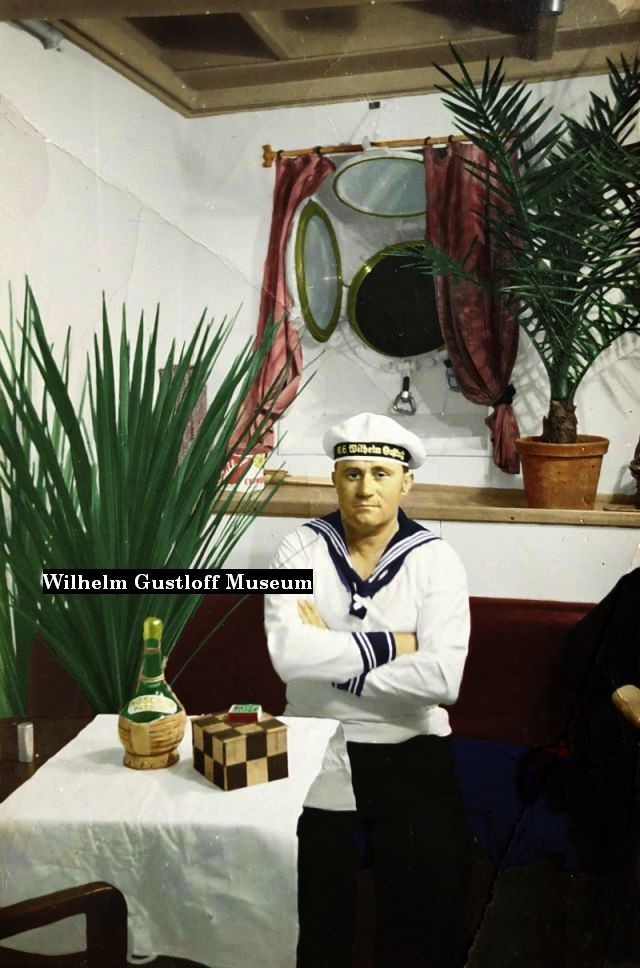
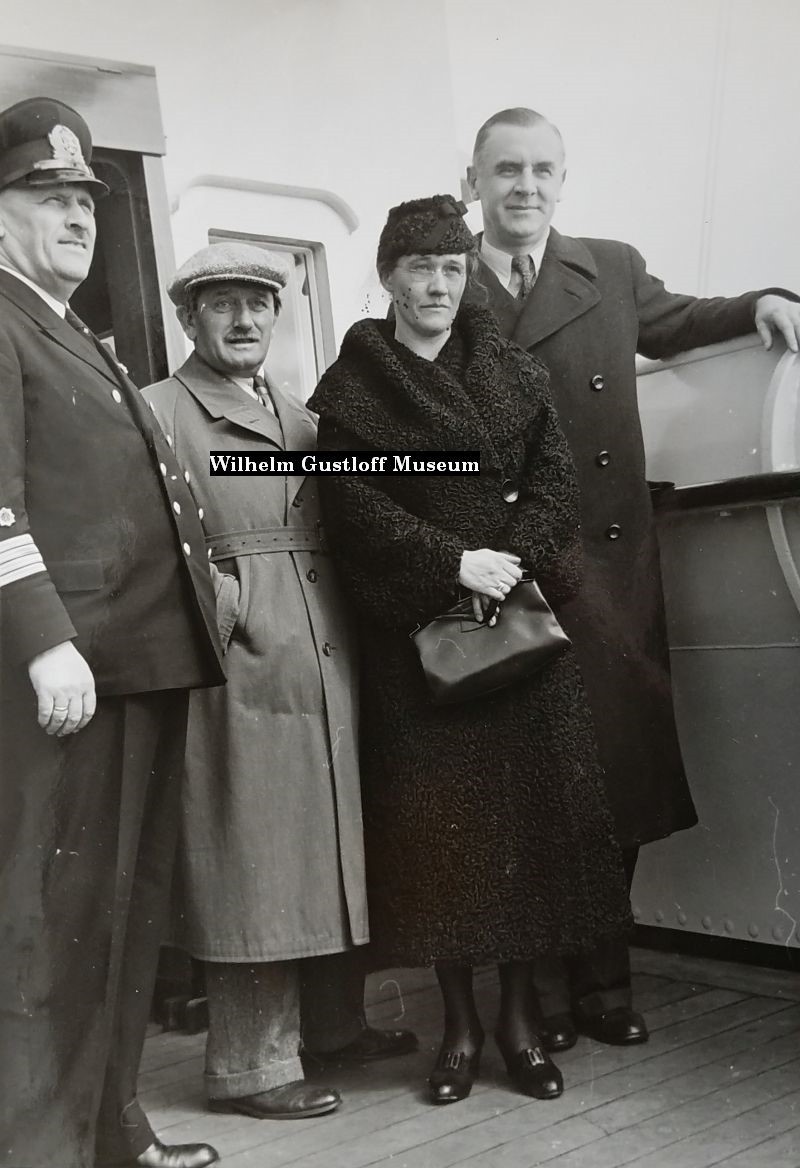
A little known gathering aboard the Wilhelm Gustloff.
Taken on the Wilhelm Gustloff's starboard bridge wing, likely on April 21st - the first day of her official maiden voyage when Frau Hedwig was known to have been aboard. It would mean this was one of the last photos taken of Captain Lübbe, as he would be dead the next day from a heart attack.
There is a caption on the back, but part of it is missing. I was able to figure out most of the information though:
"Captain Lübbe, the successful car expert Prof. Dr. Ferdinand Porsche, Mrs. Gustloff, Bodo Lafferentz, Head of the Department of Travel, Hiking, and Holidays (as a guest) on the Command Bridge.
"Sonderfahrt des 'Wilhelm Gustloff'
Kapitän Lübbe, der erfolgreiche Autokoteur Prof. Dr. Porsche, Frau Gustloff, Bodo Lafferentz, Fachamtsleiter des Amtes für Reich Wandern (als Gästerne) auf der Kommandobrücke.
Taken on the Wilhelm Gustloff's starboard bridge wing, likely on April 21st - the first day of her official maiden voyage when Frau Hedwig was known to have been aboard. It would mean this was one of the last photos taken of Captain Lübbe, as he would be dead the next day from a heart attack.
There is a caption on the back, but part of it is missing. I was able to figure out most of the information though:
"Captain Lübbe, the successful car expert Prof. Dr. Ferdinand Porsche, Mrs. Gustloff, Bodo Lafferentz, Head of the Department of Travel, Hiking, and Holidays (as a guest) on the Command Bridge.
"Sonderfahrt des 'Wilhelm Gustloff'
Kapitän Lübbe, der erfolgreiche Autokoteur Prof. Dr. Porsche, Frau Gustloff, Bodo Lafferentz, Fachamtsleiter des Amtes für Reich Wandern (als Gästerne) auf der Kommandobrücke.
The Mystery of the Yellow Funnel - Was her funnel yellow or white?
If you take notice, in several period paintings and on souvenir pieces, the Wilhelm Gustloff's funnel is depicted as pale yellow. However, throughout almost all of her career, it was white. Why? It appears that they were experimenting with funnel colors to see perhaps which they liked best. Based on photographic evidence, the Gustloff had a white funnel for her completion and sea trials. It was painted pale yellow for her unofficial maiden voyage based on two photographs. It returned to white for her maiden voyage, then it was painted yellow around May 7th, 1938. It remained yellow until her voyage for the Italian World Congress, where the last photo of her yellow funnel is taken. While in Italy, it was repainted white as seen in photos from the return trip beginning June 29th, 1938. It remained white for the rest of her pleasure cruising career.
If you take notice, in several period paintings and on souvenir pieces, the Wilhelm Gustloff's funnel is depicted as pale yellow. However, throughout almost all of her career, it was white. Why? It appears that they were experimenting with funnel colors to see perhaps which they liked best. Based on photographic evidence, the Gustloff had a white funnel for her completion and sea trials. It was painted pale yellow for her unofficial maiden voyage based on two photographs. It returned to white for her maiden voyage, then it was painted yellow around May 7th, 1938. It remained yellow until her voyage for the Italian World Congress, where the last photo of her yellow funnel is taken. While in Italy, it was repainted white as seen in photos from the return trip beginning June 29th, 1938. It remained white for the rest of her pleasure cruising career.
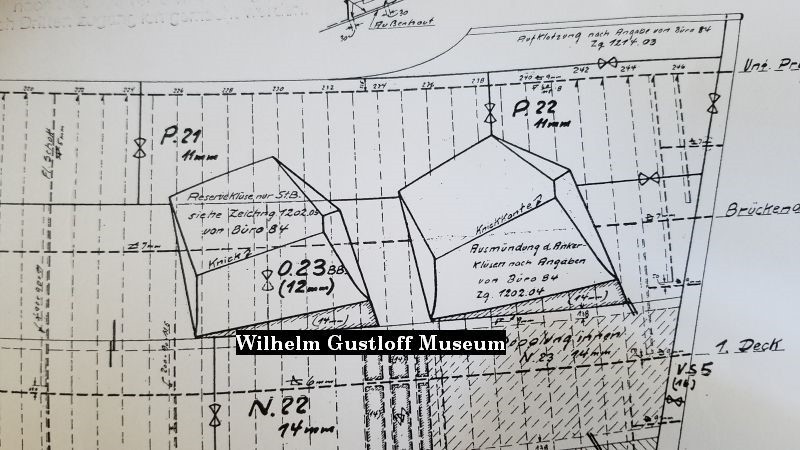
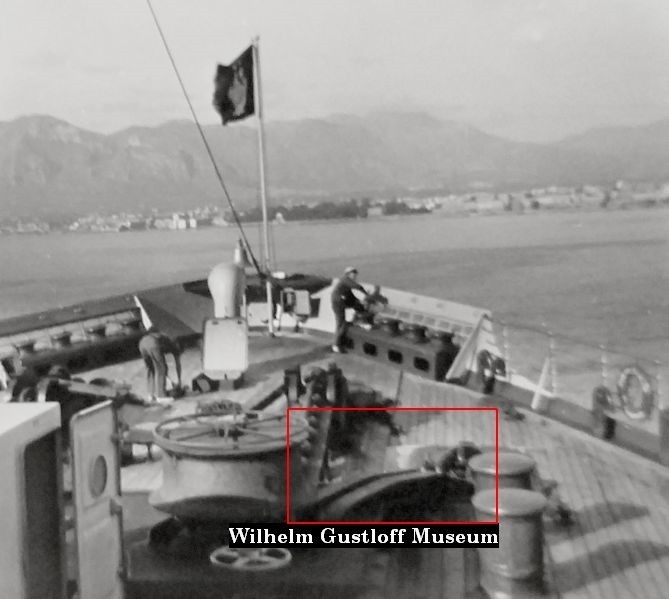
Why did the Wilhelm Gustloff have 3 anchors?
The reason the Wilhelm Gustloff had 2 anchors on her starboard side is because the second was her reserve! While some ships had their spare anchor on the bow, apparently Blohm + Voss tried something new by attaching her spare anchors off the side. The anchor klüse, or hole, is listed as reserve on the ship's blueprints. If you notice in the right photograph, there is no anchor chain going to the reserve anchor either.
The reason the Wilhelm Gustloff had 2 anchors on her starboard side is because the second was her reserve! While some ships had their spare anchor on the bow, apparently Blohm + Voss tried something new by attaching her spare anchors off the side. The anchor klüse, or hole, is listed as reserve on the ship's blueprints. If you notice in the right photograph, there is no anchor chain going to the reserve anchor either.
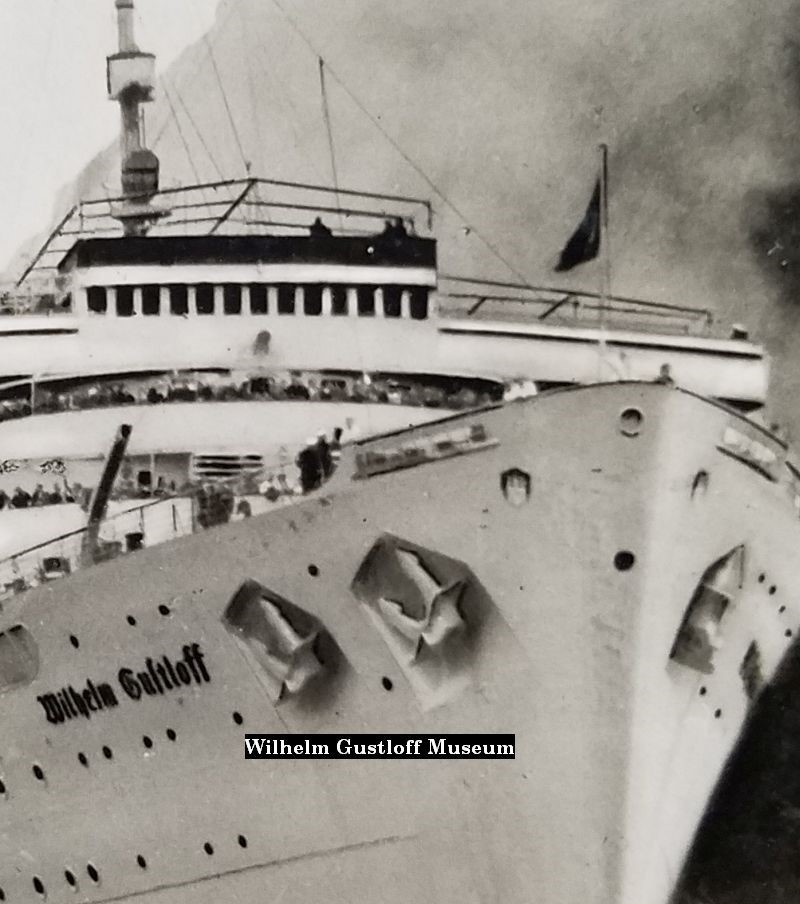
Above Left: Yellow funnel 5/15/38.
Above Right: Yellow funnel 5/1938.
Above Right: Yellow funnel 5/1938.
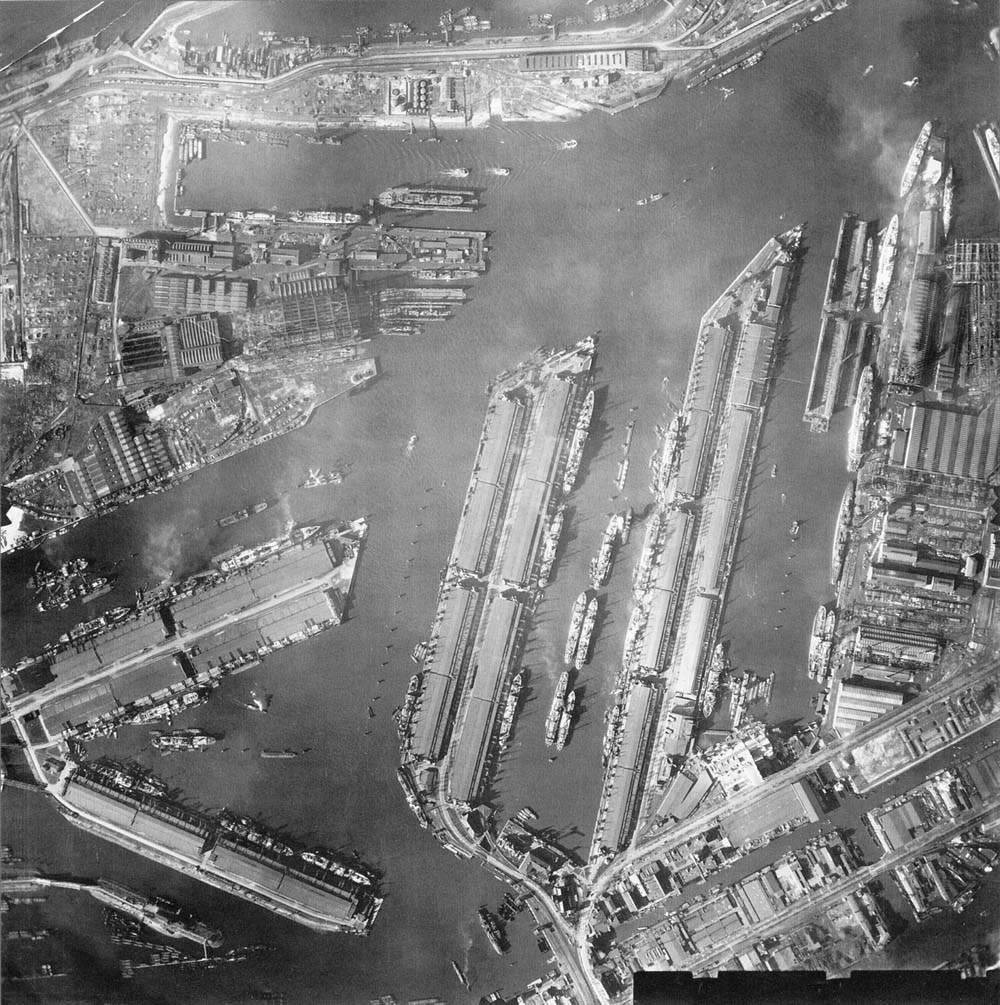
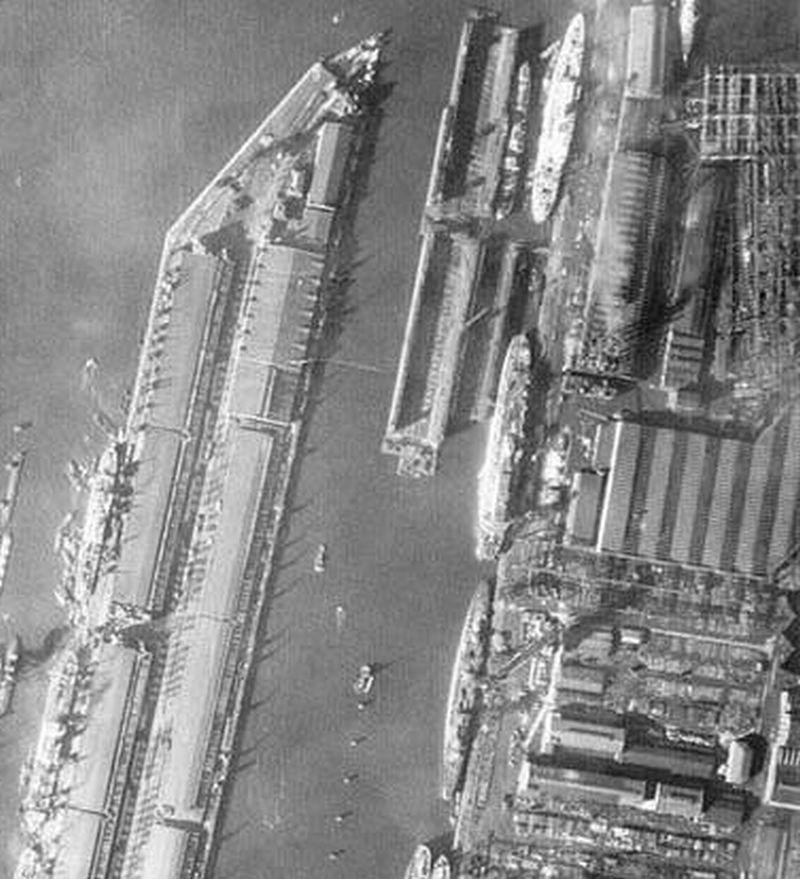
The Wilhelm Gustloff being outfitted in Hamburg, Germany. Aerial view, February 1938.
It is captioned the Admiral Hipper is just below her and the Bismarck is somewhere in the photo as well.
Original source unknown.
It is captioned the Admiral Hipper is just below her and the Bismarck is somewhere in the photo as well.
Original source unknown.
A third invitation was ordered in December 2018 with information inside about viewing the launch from one of the KdF ships on the river - Oceana, Sierra Cordoba, etc. But it was lost or stolen in the mail.
Pre-Maiden Voyage of the M.S. Wilhelm Gustloff
March 26th to March 27th, 1938
March 26th to March 27th, 1938
This voyage was recently unknown until the surfacing of this ticket. Marked as an "Abnahme Fahrt", it could be another test run or inspection trip to see what worked and what didn't after her unofficial maiden voyage. Corrective actions were likely to be taken if needed. Also marked "Obersteward", so possibly a trip just for the ship's staff and crew. The earliest menu I have from the Gustloff comes from this voyage.
The last 2 photos were purchased from the same seller, but shipped separately. The second to last arrived. The last one was returned to Germany, reshipped, and then lost in the mail.
A letter signed by Wilhelm Gustloff on February 1st, 1936 - just 3 days before his assassination.
Sold at a German auction in September, 2019, I was unable to bid due to various terms of the auction house. I still wanted to share this, as it is only the second signature of his I've come across.
Sold at a German auction in September, 2019, I was unable to bid due to various terms of the auction house. I still wanted to share this, as it is only the second signature of his I've come across.
Pre-Maiden Voyage of the M.S. Wilhelm Gustloff
"Easter trip of the districts of Hamburg, Schleswig-Holstein and East Hanover"
April 13th - 18th, 1938
What was the hull color of the Wilhelm Gustloff - White or Cream?
Through the few color images and videos that exist of the Wilhelm Gustloff, you may notice that sometimes she appears to be all white (right), and others she looks like she is painted in a cream or eggshell color. I recently came across this beautiful color bow shot of the Wilhelm Gustloff online from the Akira Takiguchi photo collection (far right). This is also evident in her color video footage under the Voyages page.
The answer is simply that she was both colors at some point in her career. As with her funnel, it seems like they were trying to figure out which colors the ship would look best in and she was repainted throughout her career. The problem is that there is no timeline as to when she was white or when she was cream colored. It is difficult to tell with black and white photographs.
One other change with the ship is that early on in her career, she had the tarp rigging across her bow. It was removed soon after, never to be replaced.
Through the few color images and videos that exist of the Wilhelm Gustloff, you may notice that sometimes she appears to be all white (right), and others she looks like she is painted in a cream or eggshell color. I recently came across this beautiful color bow shot of the Wilhelm Gustloff online from the Akira Takiguchi photo collection (far right). This is also evident in her color video footage under the Voyages page.
The answer is simply that she was both colors at some point in her career. As with her funnel, it seems like they were trying to figure out which colors the ship would look best in and she was repainted throughout her career. The problem is that there is no timeline as to when she was white or when she was cream colored. It is difficult to tell with black and white photographs.
One other change with the ship is that early on in her career, she had the tarp rigging across her bow. It was removed soon after, never to be replaced.
Above Left: Hamburg, August 1939.
Above Right: Noted as an Italian cruise between 1938 and 1939.
Above Right: Noted as an Italian cruise between 1938 and 1939.
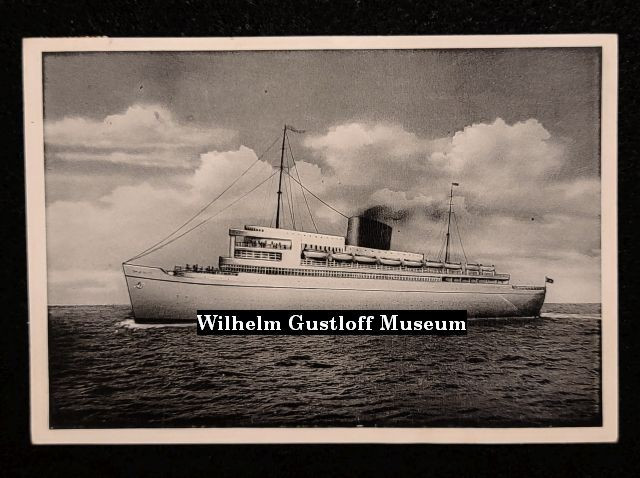
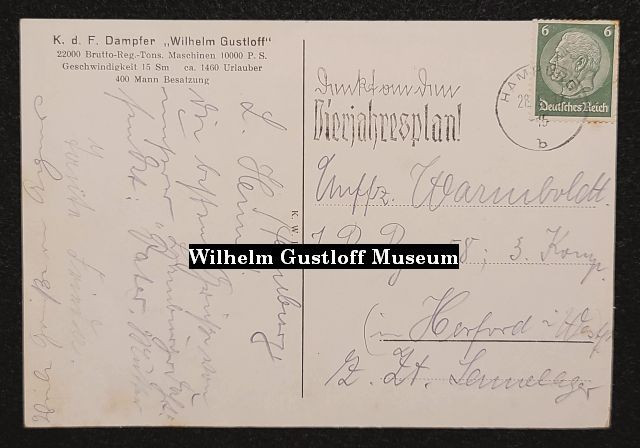
The earliest Wilhelm Gustloff postcard there is. Postmarked May 28th, 1937, it is an artist rendering of the finished ship launched less than a month prior. The artist could only use models depicting what the finished ship would look like when completed the following year. The statistics on the back are also off - stating the ship is 22,000 GRT compared to the actual 25,484 when she would be finished.
Below: Captain & crew on the bridge of the Gustloff. 3/25/38.
Final row above: From a photo album from a couple in Germany that primarily features snowy scenes from 1935 and their wedding photos from 1939. Several photos were severely damaged when they were attempted to be removed, leaving only small portions left. Many photos are missing completely. Fortunately, the pages I wanted are fully intact! The couple attended the launch of the Wilhelm Gustloff on May 5th, 1937! There are 2 photos of Hamburg Harbor, and 7 of the launch itself! The 8th launch photo from the album features a photo I've never seen before - instead of focusing on the launch of the Gustloff, the camera turned around and snapped this image of the main stand and spectators at Blohm + Voss. A very unique view indeed!